
 Walk into any commercial timber processing facility in the UK — whether a hardwood sawmill in the Scottish Highlands, a furniture component plant in the English Midlands, or a joinery workshop supplying London’s construction trade — and you will almost certainly encounter bandsaw machines, circular saws, and planer-thicknessers running at spindle speeds anywhere between 1,500 and 5,000 RPM. The mechanical demands placed on these spindle drive systems are relentless: high rotational inertia, variable cutting loads, continuous vibration, and an operating environment perpetually contaminated with sawdust, wood chips, and fine timber particles. In these conditions, the bushing that connects a motor pulley or blade-holding hub to the machine spindle becomes a genuinely critical component — one that either supports consistent, profitable production or quietly undermines it through slippage, fretting wear, and unplanned downtime that costs money every minute the machine stands idle.
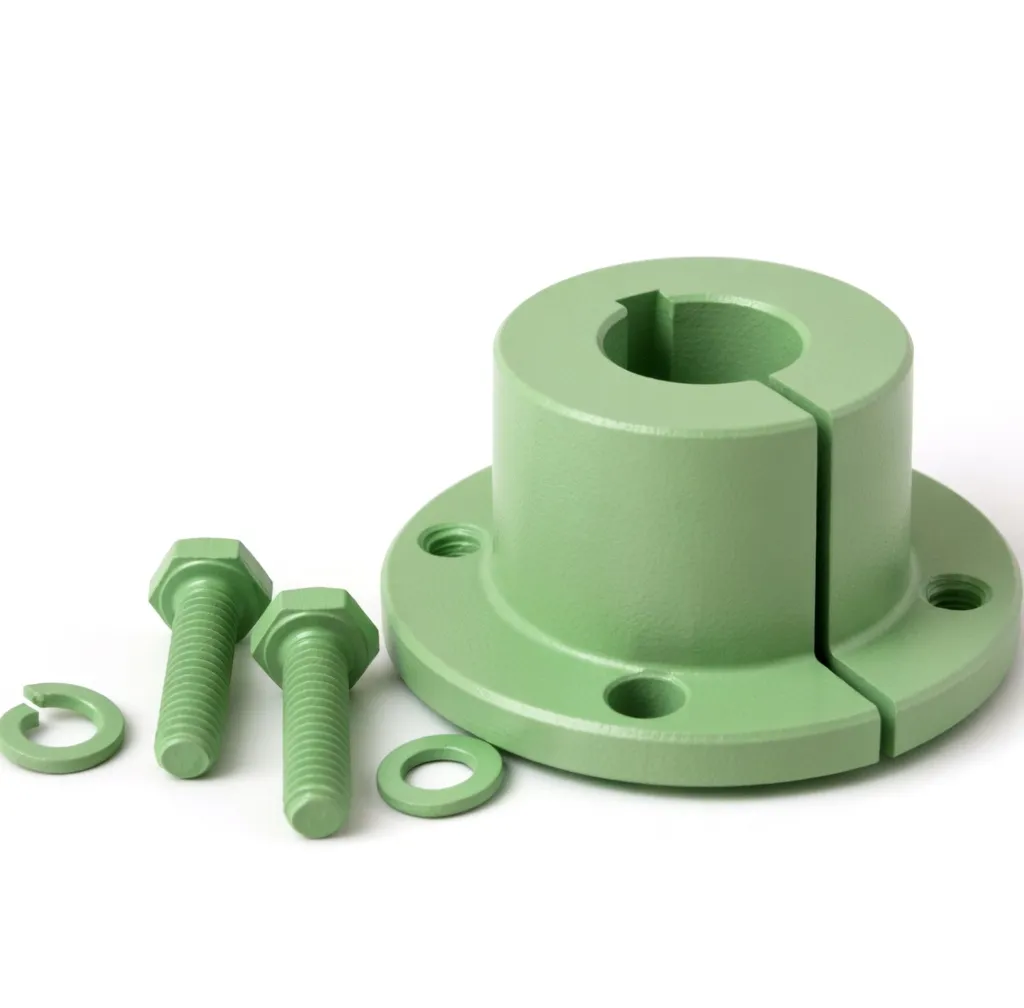
QD bushings — the shorthand for Quick-Detach bushings — have become the preferred fitment on spindle drive pulleys and blade-clamping assemblies across the timber and furniture manufacturing sector. Their tapered-bore design creates a mechanically locked, zero-clearance interference fit with the spindle shaft, eliminating the micro-movement that causes fretting corrosion under reversing loads. More importantly for production scheduling, QD bushings allow a maintenance technician to remove and refit a saw blade pulley or drive wheel in a fraction of the time needed with a conventional keyed-and-pressed hub. In industries where blade life is measured in hours rather than weeks, that rapid changeout capability translates directly to fewer minutes of dead machine time per shift — and over a full year of production, the cumulative saving is substantial.
This guide is written for UK maintenance engineers, machine shop managers, and procurement buyers who are evaluating QD bushings for existing woodworking machinery upgrades or specifying drive components for new installations. The information draws on more than eighteen years of application engineering experience across bandsaw, circular saw, planer, and panel processing machinery of all makes and vintages.
Ready to upgrade your woodworking spindle drive?
Our engineering team specifies QD bushings for timber processing, furniture manufacturing, and joinery applications across the UK and Europe. Tell us your shaft diameter, pulley bore, and spindle speed — we will recommend the exact QD bushing specification you need, with a formal quotation issued within 24 hours.
Why Woodworking Machinery Demands QD Bushings
Six performance advantages that matter on the shop floor every single shift
Rapid Blade & Tool Changeout
In hardwood processing, circular saw blades require resharpening every two to four hours under heavy cutting conditions. QD bushings reduce spindle pulley removal to a three-bolt operation that any machine operator can complete in under five minutes — compared with 25 to 40 minutes using a conventional pressed-hub arrangement requiring a hydraulic puller. Across a three-shift production day on a busy rip saw line, this time saving has a measurable, documented impact on Overall Equipment Effectiveness. Multiply that across six or eight machines in a busy Midlands furniture factory, and the productivity gain becomes a genuine competitive advantage over rivals still running legacy hub configurations.
Zero-Clearance Interference Fit
The self-locking taper of a QD bushing generates a radial clamping force of several tonnes across the shaft-to-bore interface when correctly torqued to specification. This eliminates shaft-to-hub clearance to effectively zero, preventing the fretting corrosion and key brinelling that plague conventionally keyed pulleys running under the cyclical, reversing loads of a saw spindle start-stop cycle. On machines that start and stop dozens of times per shift — automatic feeders, CNC routers, sliding table saws — this elimination of micro-movement is the single biggest driver of longer spindle shaft service life.
Built-In Dust & Debris Resistance
Woodworking generates prodigious volumes of sawdust and fine timber particles that infiltrate every gap in a drive system. The tapered, self-seating geometry of QD bushings leaves no axial gap for sawdust ingress at the critical shaft-to-bore interface, unlike flanged hub collars with exposed set-screw recesses. Coupled with the correct application of anti-seize compound on the bushing taper at installation, QD bushings maintain their clean-release characteristics even after extended operation in the dusty environments typical of UK sawmills and furniture factories — a practical advantage that becomes clear the first time a maintenance team tries to pull a corroded conventional hub from a seized shaft mid-production.
True Concentric Running
Belt-driven spindles that run out of concentric alignment generate harmonic vibration that degrades cut quality and accelerates bearing wear at a surprisingly rapid rate. QD bushings machined to AGMA or equivalent standards provide concentric repeatability within 0.025 mm TIR, ensuring that every blade or cutter re-installed after resharpening returns to precisely the same running position as its predecessor. This consistency matters enormously in furniture manufacturing, where the smoothness of a ripped panel edge or a planed face is a direct commercial differentiator — customers for high-end kitchen and bedroom furniture are quick to notice variability in surface finish, and the knock-on effect on rework and rejection rates is real.
Universal Shaft Compatibility
A single QD bushing series spans a wide range of bore sizes through precision machining, accommodating shaft diameters from 19 mm to well over 130 mm within one bushing flange OD. This universality is invaluable in mixed-fleet UK woodworking operations where equipment from multiple manufacturers — SCM, Wadkin, Robland, Felder, Robinson, and various OEM rebuilds — must share a common maintenance inventory. Rather than stocking a unique set of proprietary hubs for each machine make, a well-specified QD bushing programme can consolidate spare parts across an entire factory floor, reducing both inventory cost and the risk of ordering errors.
Reduced Total Cost of Ownership
While the unit purchase cost of a QD bushing assembly may be marginally higher than a plain bored hub, the lifecycle economics strongly favour QD technology. Reduced maintenance labour, eliminated shaft damage from pulley removal tools, longer bearing life through vibration reduction, and fewer blade damage incidents from spindle runout combine to deliver total cost savings that typically repay the upgrade investment within a single operating year for any continuously running sawmill or furniture production line in the UK. A site-specific cost justification model is available on request with any quotation we provide.
Engineering Principle & Material Construction
The Self-Locking Taper Principle
QD bushings operate on the same foundational engineering principle as a Morse taper or a hydraulic collet chuck: a precisely machined external taper on the bushing body engages against a matching internal taper in the driven component hub bore. As the mounting bolts are tightened to the specified torque, the bushing is drawn axially inward into the hub, generating enormous radial clamping forces that far exceed those achievable with a keyway and set-screw arrangement of equivalent diameter. For a typical saw machine spindle running at 3,000 RPM under a 15 kW motor, the resultant grip force provides a safety margin of 3:1 or better against the peak driving torque — including the shock loads that occur when a blade binds in a gummy tropical hardwood or encounters a hidden resin pocket in a structural timber baulk.
The mating surfaces of the taper also act as a natural barrier to dust ingress. The clamping pressure closes any microscopic gap at the tapered interface, preventing sawdust from working its way between the shaft and bore — a failure mode that is particularly destructive in fine-particle environments such as those found in MDF processing or fine furniture production where the shaving dust is as fine as talcum powder.
Material Grades for Woodworking Environments
Standard QD bushings for woodworking spindle applications are machined from Grade 1045 medium-carbon steel, offering a tensile strength of approximately 620 MPa and excellent machinability for precise bore finishing. The bore interior receives a phosphate or zinc-plating treatment to inhibit rust — a real concern in UK workshop environments where ambient humidity fluctuates markedly between seasons. Cast iron variants provide a cost-effective option for light and medium-duty planer spindles where vibration damping is the primary concern.
For facilities processing tropical hardwoods or chemically treated timbers — both common in UK contract furniture manufacturing and structural engineered wood production — a stainless steel grade QD bushing (typically 304 or 316) is the correct specification. Teak, iroko, and pressure-treated softwoods all contain acidic or alkaline compounds that attack bare carbon steel surfaces over time. Facilities handling CCA or copper-azole-treated lumber will find the additional cost of stainless QD bushings repays itself within months through elimination of the corrosion-related seizure events that otherwise disrupt maintenance schedules.
Technical Specifications: QD Bushing Series for Saw Machine Spindles
Reference data for standard steel QD bushings used in bandsaw, circular saw, and planer spindle drive systems. Custom bore sizes and materials available on request — see the factory section below.
| Bushing Series | Bore Range (mm) | Max. Torque (N·m) | Max. RPM | Flange OD (mm) | Typical Woodworking Application |
|---|---|---|---|---|---|
| JA / SDS | 19 – 32 | 85 | 6,000 | 74 | Light-duty planer motor pulleys; scroll saw drives |
| SD / SDH | 19 – 45 | 150 | 5,500 | 91 | Bandsaw upper wheel drives; thicknesser pulleys |
| SK | 22 – 65 | 280 | 4,500 | 120 | Circular saw spindle motor pulleys; planer cutter blocks |
| SF | 32 – 75 | 420 | 4,000 | 140 | Industrial rip saw & dimension saw spindle drives |
| SH / E | 38 – 90 | 650 | 3,500 | 170 | Heavy-duty frame saw & gang rip saw drives |
| F / G | 65 – 130 | 1,100+ | 3,000 | 220+ | Large-diameter log band saw; LVL and glulam line drives |
* Torque values are for single-key configuration on 1045 carbon steel. Non-keyed (friction-only) ratings are approximately 60% of listed values. RPM values assume balanced pulley assemblies and correct bearing clearances on a rigid machine bed.
QD Bushing Applications Across UK Woodworking Machinery
How different machine types benefit from QD bushing spindle drives in timber and furniture production
Customer Success Story
How a Scottish sawmill cut maintenance downtime by over 60% with QD bushing upgrades
Cairnmhor Timber Ltd — Aberdeenshire, Scotland · Commercial Softwood Sawmilling
Cairnmhor Timber operates three continuous-feed resaw lines processing Sitka spruce and Scots pine, running two production shifts daily to serve a growing order book from Scottish and Northern English house builders. Prior to engaging with our engineering team, their main bandsaw drive pulleys used a pressed-hub arrangement that had been standard on their SCM bandsaw units since original installation. The problem emerged progressively as blade change frequency increased following a new contract to supply dressed construction timber to a large Aberdeenshire developer: the repeated use of hydraulic pullers to remove drive pulleys was causing detectable shaft fretting at the pulley seats. Within eight months of this increased workload, one shaft had worn beyond the original manufacturer’s concentric tolerance and required a replacement — a £4,200 unplanned repair that also caused 36 hours of production stoppage, with knock-on effects on customer delivery commitments that strained a commercially important relationship.
Following a site visit and spindle measurement survey, our team specified SF series QD bushings for all three bandsaw drive pulleys and SK series bushings for the motor side of each belt drive. The bushings were custom-bored to match the existing SCM shaft diameters and supplied with zinc-phosphate surface treatment appropriate to the wet-wood and sawdust environment. Installation was carried out during a planned Saturday maintenance window — four hours total across all three machines, including alignment checks and a full test run under load.
Across the following twelve months of production: blade change time at each machine fell from an average of 31 minutes to under 7 minutes; zero shaft fretting events occurred at any of the three pulley locations under scheduled inspection; upper blade guide bearing life extended by approximately 30% as a result of improved spindle concentricity; and total maintenance cost savings across the three lines amounted to approximately £8,500 versus the previous year. The operations manager noted specifically that the ability to carry out blade changes during brief production pauses — something not practically possible with the hydraulic-puller system — transformed scheduling flexibility on the busiest days of the contract season.
What UK Woodworking Professionals Say
“We swapped every motor pulley on our Wadkin dimensioning saws to QD bushings three years back. Blade change time went from the best part of a morning to about fifteen minutes per machine. The payback was almost immediate, and the shafts look perfect at every inspection. I would not go back to the old system.”
— James R., Maintenance Manager · Hardwood Furniture Components, West Midlands
“We process iroko and teak for contract joinery, and the old keyway pulleys would corrode solid inside twelve months. The QD bushings with stainless coating have been running for over two years now without a single seizure. Our workshop productivity in Bristol has genuinely improved as a result — fewer unplanned stoppages and better confidence in the maintenance schedule.”
— Sandra P., Workshop Director · Specialist Joinery, Bristol
“We supply kitchen fronts to developers across Manchester and Leeds. The quality of our ripped panel edges improved noticeably after fitting QD bushings on the saw spindle drive pulleys — the blades simply run more concentrically and the cut finish is sharper. Several customers commented on the improvement without knowing we had changed anything. That speaks for itself.”
— Tom K., Production Director · Panel Products Manufacturer, Yorkshire
Manufacturing Capability
Custom QD Bushing Solutions for Every Woodworking Spindle
Our factory operates CNC turning centres, precision bore grinding equipment, and in-house heat treatment facilities, enabling us to produce custom QD bushing assemblies to exact customer specifications with lead times that UK distributors and end-users consistently describe as among the best in the sector. We hold stock of all standard QD bushing series from SDS through to the G series, with custom bore sizes machined to H7/h6 tolerance as standard output. Our quality management system requires 100% dimensional inspection on custom-bored bushings before despatch, with full traceability documentation available on request — an important consideration for customers maintaining ISO 9001-certified manufacturing facilities.
Our Production Capabilities
CNC Precision Boring
±0.01 mm bore tolerance, H7/h6 standard
Material Options
1045 steel, 304/316 SS, cast iron, alloy steel
Surface Treatments
Zinc-phosphate, EN plating, hot-dip galvanising
Keyway Standards
DIN 6885 · ANSI B17.1 · BS 4235 compatible
UK Lead Time
Standard: ex-stock | Custom: 7–14 working days
Frequently Asked Questions
Common questions from UK woodworking and furniture manufacturing buyers — click any question to expand the answer
Ready to Upgrade Your Woodworking Spindle Drive?
Contact our application engineering team for QD bushing specification, custom bore machining, and competitive pricing for UK delivery. We respond to every technical enquiry within 24 hours.
edit by gzl