
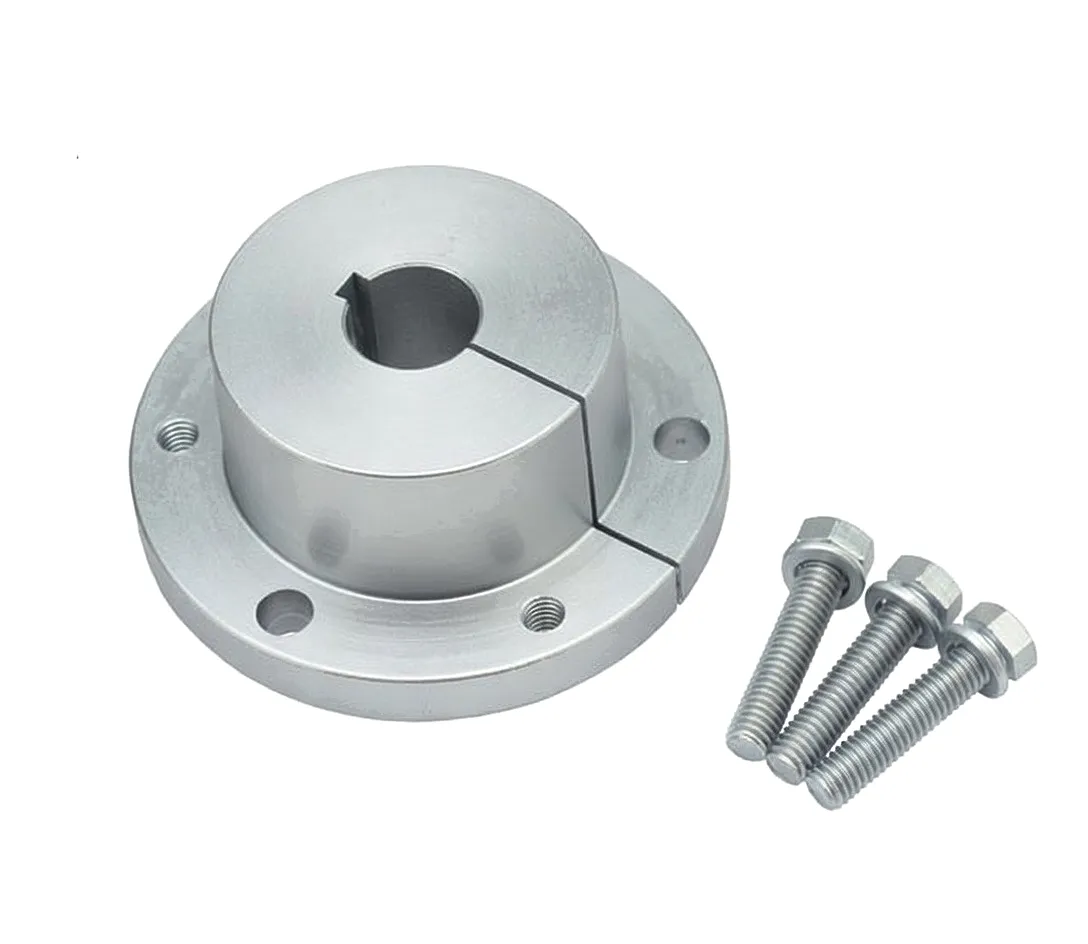
 Wind turbines rising 80 to 180 metres above British soil live in a hostile mechanical world. Nacelles rotate continuously to chase shifting winds across the North Sea, while rotor blades pitch every few seconds to shed aerodynamic load before a gust overwhelms the drivetrain. Somewhere between the motor output and that massive slewing ring sits a small steel hub carrying the entire torque burden. QD bushings fill that exact role across modern yaw and pitch architectures, holding pinion gears onto gearbox output shafts with enough clamping force to survive twenty years of thermal cycling between Scottish winters and high summer cabinet temperatures.
Replacing a failed pinion coupling 100 metres above ground demands jack-up vessels, 600-tonne cranes, and a maintenance window British operators simply cannot afford to repeat. Engineers specifying QD bushings for a new Siemens Gamesa, Vestas, or Nordex platform are choosing a connector that refuses to back off, refuses to fret, and refuses to leak torque across two decades of variable-amplitude fatigue loading.

QD bushings mounted on a 6 MW turbine yaw-drive pinion after sea-fog salt exposure testing
Why Drivetrain Engineers Specify Our QD Bushings
Keyless Clamping Integrity
Tapered split-cone geometry transforms axial bolt tension into uniform 360-degree radial grip on the pinion gear. No stress concentrations, no backlash, no progressive fretting. Reversing-torque cycles on pitch drives hit the joint millions of times yearly; QD bushings refuse to loosen where keyways wallow out.
Aerial Serviceability
Technicians working 90 metres above ground install or remove the drive pinion without pullers, induction heaters, or hydraulic kits. A QD bushing releases with standard Allen keys, slides off the shaft, and reinstalls in under thirty minutes, shortening scheduled yaw-gear replacements by roughly 40 percent.
Coastal Corrosion Shield
Every bushing destined for a British coastal installation carries a C5-M zinc-nickel electroplated finish, supplemented by chromate conversion and anti-fretting sealant. Salt-fog endurance exceeds 1,000 hours under ISO 9227, clearing the 720-hour threshold demanded by Yorkshire and Firth of Forth offshore developers.
Certified Dimensional Control
Each QD bushing is CNC-turned from 1045 medium-carbon steel or 40CrMo alloy, thread-rolled, induction-hardened on the taper, and 100-percent gauge-inspected for concentricity within 0.02 mm. British OEMs receive traceable batch certificates, ultrasonic reports, and Machinery Directive 2006/42/EC declarations.
Wind-Grade QD Bushing Performance Parameters
| Parameter | Yaw Drive Spec | Pitch Drive Spec |
|---|---|---|
| Shaft Bore Range | 40 – 160 mm | 20 – 90 mm |
| Transmitted Torque | 4,500 – 38,000 N·m | 500 – 8,500 N·m |
| Clamping Pressure | 150 – 250 MPa | 120 – 200 MPa |
| Body Material | 1045 / 42CrMo4 | 1045 Steel |
| Surface Hardness | 28 – 35 HRC | 28 – 32 HRC |
| Plating System | Zn-Ni C5-M | Zn-Ni C4 / C5-M |
| Salt-Fog Hours | > 1,000 h ISO 9227 | > 720 h ISO 9227 |
| Operating Temp. | -40 °C to +120 °C | -40 °C to +120 °C |
| Bolt Grade | 10.9 / 12.9 | 10.9 |
| Design Service Life | 20 years / 140,000 h | 20 years / 140,000 h |
How Tapered Split-Cone Clamping Works
⚡ The Mechanical Principle
A slotted steel sleeve with a four-degree outer taper fits into a matching tapered bore inside the pinion hub. Four or six Grade 10.9 cap screws tighten against the hub flange, drawing the sleeve axially into the taper. The sleeve contracts radially onto the motor shaft, producing a friction-locked joint capable of transmitting anywhere between 500 N·m on a small 2 MW pitch system and 38,000 N·m on a 10 MW direct-drive yaw module.
🔬 Material Philosophy
The bushing body runs on medium-carbon 1045 steel hardened to 28-32 HRC, balancing elastic compliance with bolt-load retention. Heavier 8+ MW offshore platforms upgrade to 42CrMo4 tempered to 35 HRC with a nitrided contact surface. Thread profiles are roll-formed rather than cut. The matching hub casts in EN-GJS-500-7 spheroidal graphite iron, matching the alloy-steel shaft thermal expansion within 1.5 µm/m/°C for North Sea winter-summer stability.
Where QD Bushings Sit Inside the Turbine
🧭 Yaw Drive Pinion Coupling
Four to eight parallel-shaft or planetary gearmotors ring the tower top, each driving a pinion meshed with an internal slewing ring 2 to 4 metres in diameter. The QD bushings absorb shock torque during emergency stops when the yaw brakes engage at 85 percent rated capacity.
🌀 Pitch Drive Blade Control
Inside every hub, three dedicated pitch motors rotate each blade root bearing through roughly 90 degrees between feather and full-power positions. The pitch pinion mounts on a QD bushing that survives continuous torque reversals at 4 to 8 cycles per minute during active load control.
❄️ Nacelle Cooling Fan Drives
Auxiliary QD bushings couple gearbox cooling-fan motors, generator intake blowers, and hydraulic power pack shafts. Small diameters, high duty cycles, and zero-tolerance for slip define the spec. British offshore fleets cycle these components continuously for 8,000+ hours per year.
🔌 Slip-Ring & Slew Gear Mounts
High-precision QD bushings anchor slip-ring transfer assemblies and auxiliary slew-gear take-offs where backlash destroys data signals. Micron-level runout tolerance is held through hardened, ground, and select-fit sleeve pairs shipped with individual calibration tags.
Scottish Onshore Retrofit: 96% Coupling Failure Reduction
The Challenge
A 50-turbine wind farm commissioned in 2022 near Glasgow experienced recurring pitch-motor coupling failures during its first 18 months. Original keyed taper-lock couplings were shedding micro-particles into the planetary gearbox, triggering premature bearing wear and unscheduled pitch-system lockouts averaging 2.3 events per turbine per year.
The Solution
The O&M contractor, a tier-1 energy services group headquartered in Aberdeen, specified replacement QD bushings manufactured in custom metric configuration with extended hub lengths and zinc-nickel plating. Installation was completed across 11 weeks in rolling shifts.
📊 Verified Outcomes
This Glasgow project has since become the reference template for pitch-drive retrofits across three additional sites in the Scottish Borders, with another 120 turbines scheduled for conversion before the 2026 summer maintenance window closes.
What British Wind Engineers Tell Us
Delivery times matter in our industry. Our Grimsby-based offshore service fleet received a batch of 240 custom QD bushings in 19 days flat, with full material traceability and salt-spray certification. Fit on the Vestas V174 pitch motors was first-time correct.
We retrofitted QD bushings across 32 turbines in our Welsh wind portfolio last summer. Vibration levels at the pitch gearbox bearings dropped 34 percent within two weeks. The engineering support during dimensional review was genuinely consultative rather than transactional.
Eighteen years specifying couplings for heavy industry and this is the first supplier who actually shipped revised tolerance drawings the same day we raised the technical query. Our Newcastle gearbox factory now runs six production lines on QD bushings sourced directly from them.
Questions from UK Wind Engineers
❓ Where can UK wind operators buy certified QD bushings for pitch drives in 2026?
British wind farm operators sourcing certified QD bushings for pitch-drive retrofits typically specify full material traceability, ISO 9001 documentation, and salt-spray performance above 1,000 hours. Direct purchase from the manufacturer with dedicated UK account support delivers the sharpest price and shortest lead time. A single email to our sales desk secures a technical review and fixed quotation within 48 hours.
💷 How much does a replacement QD bushing for a 5 MW turbine cost this year?
A standard replacement QD bushing matched to a typical 5 MW pitch or yaw pinion retails between £85 and £320 depending on bore size, plating grade, and order volume. Frame agreements for British operators managing 50 or more turbines unlock further tiered discounts. Custom engineering variants with nitrided surfaces or non-metric threads carry a modest tooling surcharge on the first order only.
🔧 Which QD bushing size fits a Vestas V150 pitch gearbox pinion shaft best?
Most V150 pitch gearboxes use a 45 mm or 55 mm output shaft paired with an SDS or JA series QD bushing depending on vintage. We recommend sharing the OEM drawing number or shaft outer diameter with our engineering desk, who return a dimensionally correct proposal inside one working day. Replacement bushings ship from stock for the most common shaft sizes in Grimsby, Hull, and Aberdeen.
🌊 What surface treatment is required for QD bushings on North Sea offshore wind turbines?
Offshore installations exposed to North Sea salt spray demand a minimum C5-M corrosion category surface system per ISO 12944. Our QD bushings are specified with zinc-nickel electroplating, chromate conversion layer, and an anti-fretting top seal, achieving more than 1,000 hours of salt-fog endurance under ISO 9227. Stainless steel variants are available for splash-zone components near the transition piece.
🗓️ When should a British maintenance team replace worn QD bushings during major servicing?
Planned replacement of QD bushings during scheduled 5-year turbine overhauls is the prudent path, even when visual inspection shows no damage. Repeated thermal cycling and torque reversals gradually relax setscrew preload below the minimum clamping pressure required. Swapping bushings during a scheduled stoppage costs a fraction of reacting to an in-service pinion slip event offshore.
🏭 Who supplies custom QD bushings quickly to British wind gearbox manufacturers?
Our factory has delivered custom QD bushings to six British gearbox OEMs since 2019, with median sample lead time of 10 working days and volume lead time of 25 to 35 days FOB. Direct factory purchasing avoids the 15 to 20 percent distributor margin common across the European drivetrain supply chain, freeing budget for enhanced metallurgy specifications.
⚡ What torque rating should my pitch pinion QD bushing support on a 7 MW turbine?
Pitch pinion QD bushing rated torque depends on blade length, motor power, and reduction ratio, typically falling between 1,200 N·m and 8,500 N·m continuous on a 7 MW class machine. We size the bushing with a 2.5 to 3.0 safety factor against peak emergency-stop torque, ensuring zero slip under the worst-case aerodynamic load scenarios recorded in IEC 61400-1.
Ready to Specify QD Bushings for Your Next UK Wind Project?
Send your shaft drawings, torque data, and plating requirements. A senior application engineer responds within one UK business day with a dimensioned proposal and transparent FOB pricing.
edit by gzl