
 A cement rotary kiln is not a machine you stop for a quick inspection. These enormous cylindrical furnaces — commonly 3 to 6 metres in diameter, 40 to 100 metres long, and weighing anything from a few hundred to several thousand tonnes — rotate continuously, day and night, while raw meal inside is heated to temperatures approaching 1,450°C. Every tonne of clinker produced has passed through a process that demands absolute mechanical reliability over extended campaign periods that can stretch to 10 or 12 months without a planned major shutdown. In that operating context, every mechanical component in the drivetrain is under scrutiny, and the shaft connection joining the gearbox output to the pinion gear shaft is arguably the most critical of all.
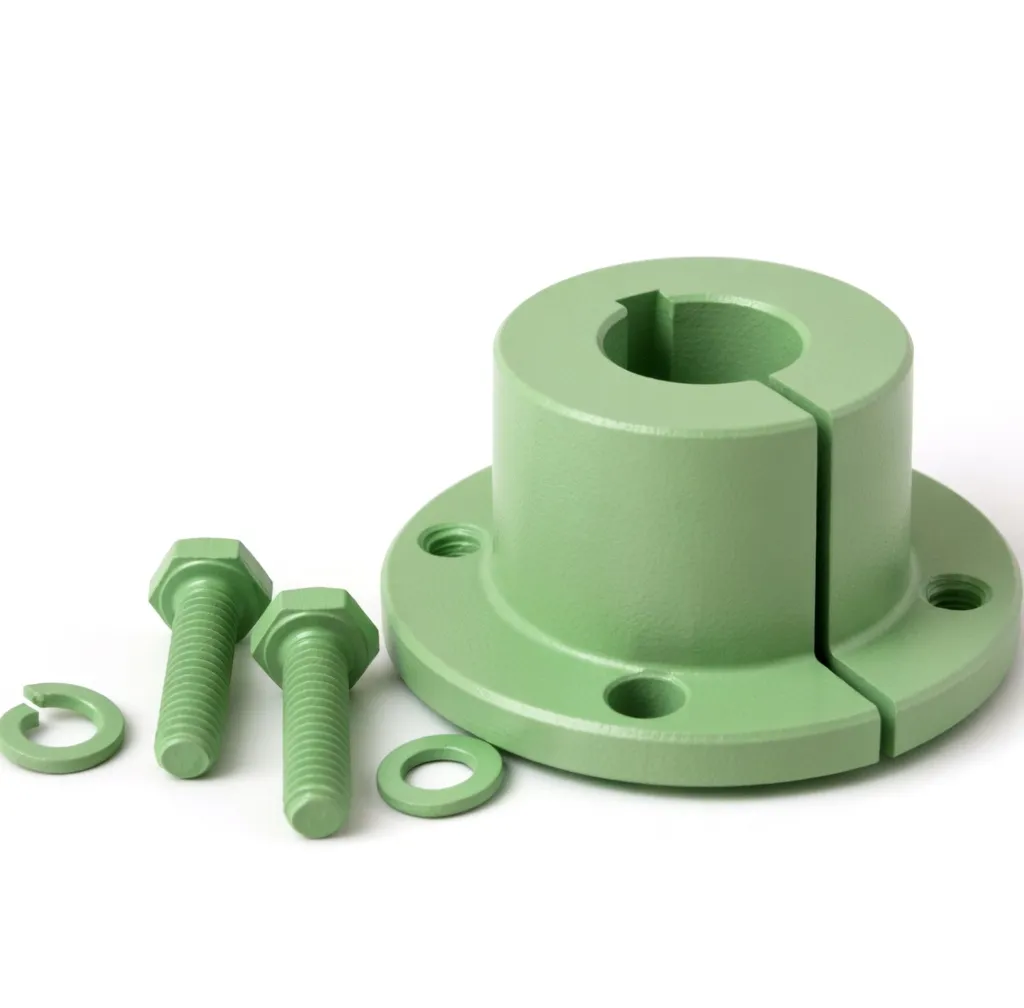
QD bushings — Quick Disconnect bushings — have established themselves as the preferred shaft locking solution at this demanding interface in cement plants across the United Kingdom and worldwide. Their tapered-bore clamping geometry transmits very high torques without relying on interference fits that are difficult to achieve and even harder to release in a hot, dusty environment. They accommodate the axial thermal expansion of kiln-adjacent shafts without loading gearbox bearings. And when it comes time to pull the drive apart during a planned stop, they come off in a fraction of the time that press-fit or shrink-fit alternatives require. This article covers the engineering reasons behind that reputation, the material choices that matter in a cement plant environment, real-world performance data from UK kiln drive applications, and the customisation capabilities that make it possible to fit QD bushings to virtually any existing kiln drive geometry.
Why Cement Rotary Kiln Drives Present Uniquely Severe Conditions for Shaft Connections
Most industrial drive systems deal with one or two complicating factors — high load, corrosive atmosphere, shock loading. Cement kiln drives combine essentially all of them simultaneously, at a scale that tests materials and mechanical designs well beyond standard catalogue ratings. The ambient temperature in the hot zone around the main drive pinion can reach 60°C or above under normal operating conditions — already at the limit of many standard lubricants and a temperature at which material fatigue behaviour changes meaningfully. Overlaid on this is a constant fine dust environment: raw cement particulate is highly abrasive, alkaline, and hygroscopic, meaning it does not just wear surfaces but creates a mildly corrosive paste whenever any moisture is present. Open shaft connections, keyways with poorly sealed interfaces, and any mechanism with significant internal clearances become sites for progressive deterioration in this environment.
The torque values involved push this well beyond what most drive applications encounter. A 5-metre diameter kiln can require 500 kNm or more of sustained drive torque. This torque is not steady: kiln start-up from cold demands breakaway torques that routinely reach 150% or more of the running value, a transient that stress-tests every fastened and fitted connection in the system. The geometry of the open gear drive — bull gear diameters of 6 to 10 metres, running at 1 to 4 rpm — concentrates that torque into a relatively small shaft interface, creating contact stresses that must be managed with precision.
Thermal expansion adds a further complication that is often underestimated. As the kiln shell reaches operating temperature, the adjacent shaft and gear components expand axially by millimetres — not a trivial amount at these shaft diameters. A shaft connection that cannot accommodate this axial movement will transmit the resulting force directly into the gearbox thrust bearings, accelerating their wear and eventually causing premature failure. UK cement plant engineers managing sites in Derbyshire, Yorkshire, and South Wales have documented this exact failure sequence in older installations using conventional shaft connections, making the case for a flexible, thermally-tolerant solution straightforward and well-evidenced.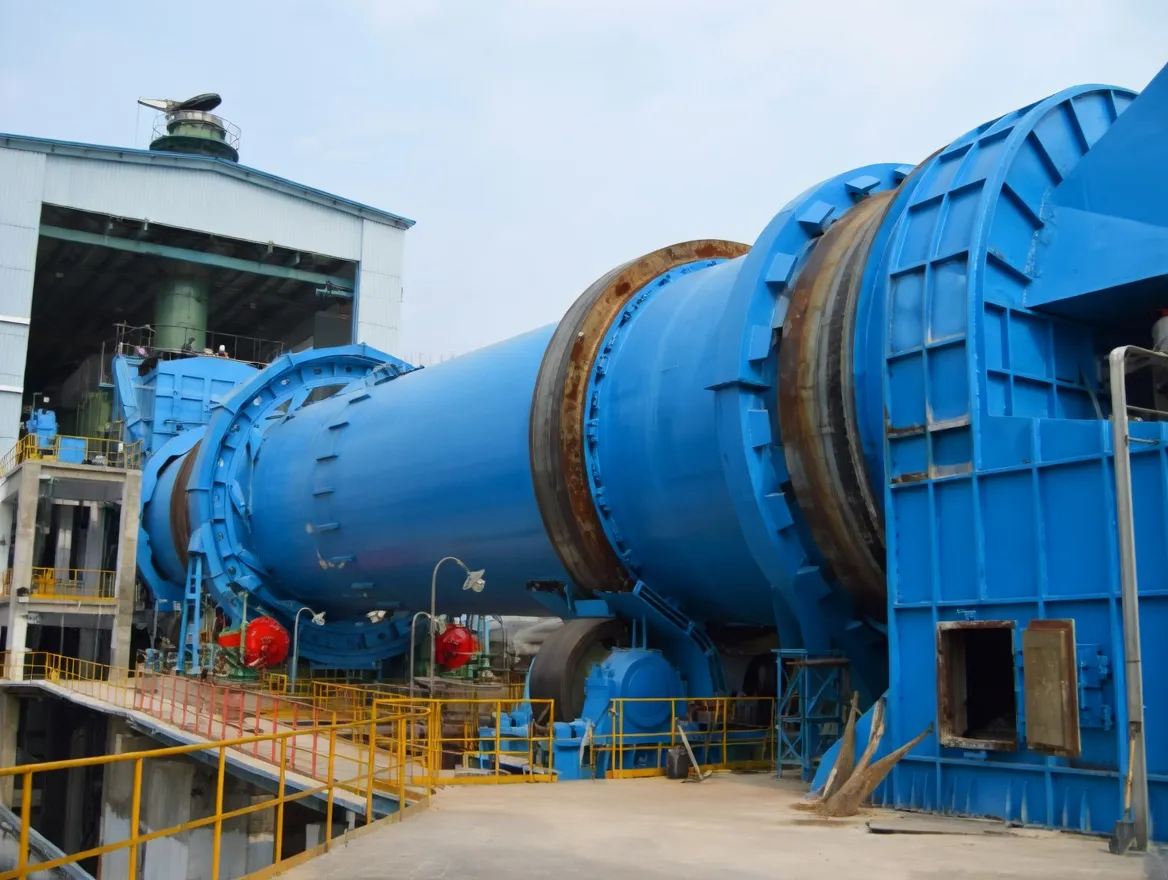
The Mechanical Principle: How QD Bushings Transmit Torque Through Taper Geometry
The QD bushing operates on a wedging principle that generates very high clamping forces from modest bolt torques. The external surface of the bushing body is machined to a precise taper — standardised at a 1:8 ratio — that fits into a matching tapered bore machined into the hub of the driven component, in this case the pinion gear. As the flange bolts are tightened, the bushing is drawn axially into the taper, and the resulting wedging action compresses the bushing tightly around the shaft while simultaneously loading the hub with a high compressive hoop stress. This creates a friction grip between bushing and shaft over a large surface area, distributing the torque transmission load far more effectively than a conventional parallel keyway.
For cement kiln drive applications, where torques are high enough that friction alone would require impractically large clamping forces, QD bushings are used with a standard parallel key. The key handles the peak torque excursions — start-up surges and material jam events — while the taper grip provides the main torque-transmitting mechanism during steady operation. This combination ensures that the key is not the sole torque carrier, eliminating the fretting micro-movement at the key flanks that is the root cause of most keyway fatigue failures in high-cycle heavy drive applications. Field evidence from multiple UK cement plants confirms that QD bushing installations using this combined taper-and-key arrangement outlast conventional keyway-only connections by a factor of three to five in terms of service life before requiring intervention.
The removal mechanism is equally well-engineered. The same threaded holes used during installation are converted to withdrawal points by threading bolts against a backing plate. This jacks the bushing cleanly out of the taper regardless of how long or how hard the installation has been in service — a critical advantage in the cement kiln environment, where thermal oxide scaling and cement contamination can make interference-fit component removal a time-consuming, potentially shaft-damaging exercise. For a plant where every hour of planned shutdown is precious, and where an extended or difficult removal can turn a planned maintenance event into an unexpected production loss, this feature alone justifies the specification of QD bushings over alternative hub connection types.
Material Selection: Matching QD Bushing Grade to the Cement Kiln Environment
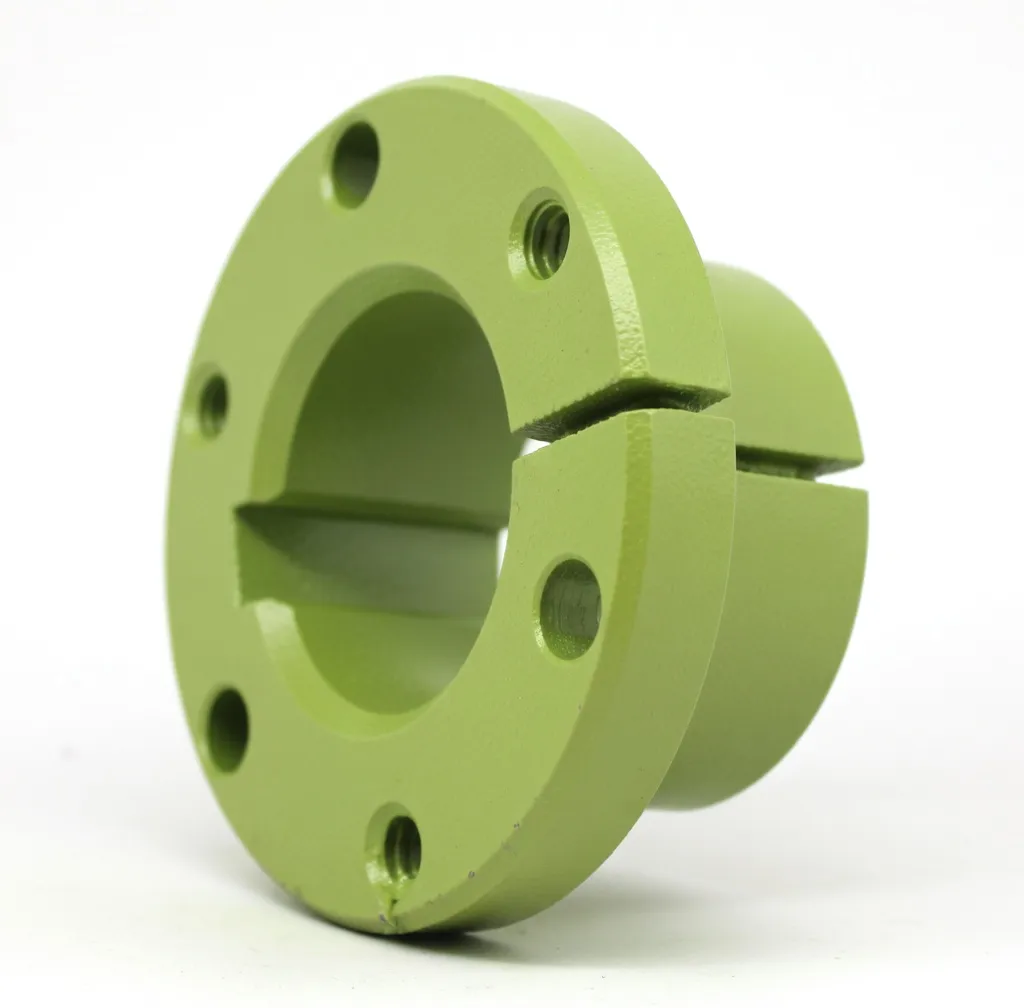 Standard catalogue QD bushings are produced in grey cast iron — typically equivalent to ASTM A48 Class 40 or BS EN 1561 Grade EN-GJL-250 — which offers good compressive strength, natural vibration damping, and excellent machinability. For moderate-duty drives in relatively controlled environments, grey iron performs entirely adequately. The cement kiln environment is a different proposition, and material selection deserves careful thought rather than a default to the cheapest available grade.
At sustained ambient temperatures above 60°C, grey cast iron’s limited ductility becomes a liability under the repeated shock loading of kiln start-ups and occasional material jam events. Ductile iron — BS EN 1563 Grade EN-GJS-500-7 — offers dramatically improved impact toughness without sacrificing the compressive strength needed for tight taper grip. The tensile strength of Grade 500/7 ductile iron is nominally 500 MPa compared to approximately 250 MPa for grey iron, and its elongation at fracture of 7% versus effectively zero for grey iron means that shock loads are absorbed rather than initiating cracks. For UK cement plants operating kilns of 3.5 metres diameter and above, ductile iron should be the default material specification for QD bushings at the main drive connection.
For the largest kilns — above 5 metres in diameter, with shaft sizes above 100 mm and peak start-up torques that test the limits of ductile iron’s rated capacity — steel QD bushings machined from 42CrMo4 alloy steel (BS EN 10083-3) provide the ultimate performance. Tensile strengths of 900 to 1,050 MPa and excellent fatigue resistance make steel grade bushings effectively immune to the failure modes that affect cast material under extreme cyclic loading. The cost premium over ductile iron is real but quickly justified when balanced against the production loss cost of a single unplanned kiln drive failure event. Surface protection matters in every case: a phosphate conversion coating and zinc-rich primer on the bore and taper surfaces dramatically reduce galvanic corrosion between the bushing and the steel shaft in the alkaline-dust-laden moisture conditions that exist around kiln drives during cool-down and start-up phases.
QD Bushing Material Comparison — Cement Kiln Drive Applications
| Material | Standard | Tensile Strength | Impact Toughness | Best Suited For |
|---|---|---|---|---|
| Grey Cast Iron | BS EN 1561 / ASTM A48 | 200–280 MPa | Low | Auxiliary drives, kilns below 3 m dia. |
| Ductile Iron 500/7 | BS EN 1563 | 500–700 MPa | High | Main kiln drives, 3–5 m diameter kilns |
| 42CrMo4 Steel | BS EN 10083-3 | 900–1,050 MPa | Very High | Mega-kilns, shafts above 100 mm, extreme peak torques |
Standard QD Bushing Technical Parameters — Kiln Drive Selection Guide
| QD Series | Bore Range | Max Torque (Nm) | Flange OD (mm) | Key Size (mm) | Bolt Qty | Typical Kiln Application |
|---|---|---|---|---|---|---|
| E | 19–52 mm | 620 | 89 | 6 × 6 | 3 | Auxiliary / cooling fan drives |
| F | 22–65 mm | 1,240 | 108 | 8 × 7 | 3 | Small kiln auxiliary pinion |
| J | 25–80 mm | 2,770 | 140 | 10 × 8 | 3 | 3 m kiln main pinion |
| M | 32–95 mm | 5,090 | 171 | 12 × 8 | 4 | 3.5–4 m kiln main drive |
| P | 38–120 mm | 8,475 | 216 | 16 × 10 | 4 | 4–5 m kiln main drive |
| Q | 44–140 mm | 13,560 | 267 | 18 × 11 | 4 | 5–6 m large kiln drive |
| SH Custom | 50–200 mm | 28,000+ | Specified | Custom | Custom | Mega-kilns, bespoke order only |
* Torque values shown for standard grey cast iron grade. Ductile iron and steel grades carry higher rated capacity. Custom bore sizes, keyway dimensions, and hub face configurations available on request.
Six Reasons UK Cement Plant Engineers Specify QD Bushings for Rotary Kiln Drive Systems
Exceptional Torque Density
The wedging action of the tapered interface generates contact pressures across a large surface area, delivering very high torque capacity within a compact hub envelope. This matters on kiln drives where radial space around the pinion hub is limited by gear geometry. QD bushings allow full gearbox rated torque to be transmitted without enlarging the hub or the gear shaft diameter, preserving existing equipment geometry and avoiding costly re-engineering of proven drive arrangements.
Thermal Expansion Accommodation
As the kiln shell heats up and adjacent shafts expand axially, QD bushings accommodate controlled axial float without transmitting destructive thrust loads into gearbox bearings. This is a documented failure mechanism in kilns using rigid connection methods, and it is entirely preventable with correct QD bushing specification. Service life data from UK cement plant maintenance records shows a consistent improvement in gearbox bearing life when QD bushings replace rigid shaft connections at the pinion interface.
Rapid Planned Maintenance
The Quick Disconnect mechanism is genuine, not just a product name. Using the withdrawal bolt method — threading bolts into the pusher holes and advancing them against a fixed backing surface — an experienced fitter can remove a large Series P or Q bushing from a kiln pinion hub in 20 to 45 minutes. Removing a comparably sized interference-fit hub using a hydraulic puller and heat gun in a dusty, confined kiln drive pit can take most of a working shift. Every hour saved in planned maintenance is additional production capacity recovered.
Dust & Contaminant Resistance
The taper-clamped interface of QD bushings seals the critical torque-transmitting zone from cement dust ingress during operation. Combined with appropriate anti-corrosion coatings and properly sealed flange fasteners, QD bushings resist the progressive abrasive and corrosive deterioration that degrades open shaft connections in cement plants. This is not a marginal improvement — the difference between a sealed taper connection and an open keyway in a cement plant environment is measured in months of additional service life per maintenance cycle.
International Interchangeability
QD bushings follow an internationally standardised taper and bolt pattern (originally established by TB Wood’s in the USA and now adopted globally), meaning replacement units from multiple manufacturers are fully interchangeable. UK cement plant procurement teams can source from multiple qualified suppliers, eliminating single-source dependency and simplifying emergency spare sourcing if the primary supply route is disrupted. For maintenance storerooms that need to hold a manageable strategic spare inventory, this standardisation significantly reduces the complexity and cost of the spare parts holding requirement.
Lower Total Cost of Ownership
When total cost of ownership is calculated — acquisition, installation labour, maintenance hours over a 5-year period, and the probability-weighted cost of unplanned downtime events — QD bushings consistently outperform interference-fit and clamped-ring alternatives. The acquisition cost is modest. The installation cost is low. The maintenance cost is low. And the failure probability, properly implemented, is very low. That arithmetic drives the purchasing decisions at every cement plant procurement department that has done a rigorous lifecycle cost analysis on their kiln drive shaft connections.
QD Bushing Applications Across the Full Cement Plant Drive System
The rotary kiln main drive is where QD bushings face their most extreme operating conditions, but they appear throughout the mechanical drive systems of a modern cement plant. Understanding where they are deployed and why gives a useful picture of why QD bushings have become so ubiquitous in cement plant maintenance storerooms — they are not a specialised component for one application but a genuinely versatile shaft connection solution that works across the full spectrum of drive sizes and environmental conditions found on a typical UK cement site.
The raw mill — whether a vertical roller mill or a horizontal ball mill — grinds raw limestone, clay, and corrective materials to the fine powder fed into the kiln preheater. These mills use large gear drives exposed to heavy raw material dust and significant vibration, making QD bushings the natural choice at the gearbox-to-gear shaft interface. The clinker cooler, which extracts residual heat from hot kiln output, operates at extreme temperatures and uses drive mechanisms that benefit from the same quick-release characteristic of QD bushings during planned maintenance. Finish grinding ball mills — often the largest continuous electrical loads on a cement site, running at 1,000 kW or more — rely on QD bushings at the pinion hub connection of their girth gear drives, where the combination of high continuous torque and the need for reliable, accessible maintenance makes the selection straightforward.
🔞 Rotary Kiln Main Drive
Gearbox output shaft to bull gear pinion — the highest torque, highest temperature location on the plant
🔧 Raw Mill Drive
Ball and VRM gear drive shafts in raw material grinding areas — constant dust, high vibration
⚙️ Clinker Cooler
Drive mechanisms immediately downstream of kiln discharge — extreme heat, coarse clinker dust
🌀 Finish Mill Drive
Cement grinding ball mill girth gear pinion drives — large continuous torque, 24/7 operation
Installation Practice and Maintenance Protocols for Cement Kiln Drive QD Bushings
Getting the installation right is not technically complex, but it does require discipline in a few areas that matter more in a kiln drive than in a light industrial application. Shaft and bore surfaces must be thoroughly cleaned before assembly — cement dust or oxidation scale on the taper surfaces during installation prevents full seating of the bushing in the hub taper, reducing the effective contact area and lowering the achievable clamping force below the design value. A wipe-down with clean cloth and a light film of mineral oil on the bore surfaces aids initial seating without compromising the friction coefficient of the final clamped assembly.
Bolt tightening must follow a cross-pattern sequence, advancing in stages to ensure even load distribution around the flange before reaching the final specified torque. For large Series P and Q QD bushings in ductile iron or steel grade, the final bolt torque can be 250 to 350 Nm — well beyond what hand-tightening achieves, and the difference is not small. Insufficient installation torque is the most common preventable cause of in-service micro-movement at the taper interface, which produces fretting corrosion, progressive hub damage, and eventually the same connection loosening problems that the QD bushing was meant to prevent. Using a calibrated torque wrench and following the manufacturer’s specified values is genuinely non-optional for this application.
During planned kiln stoppages, a brief inspection of the bushing flange takes only minutes but provides valuable early warning information. Any fretting oxide deposits around the bolt holes, elongation of the drilled installation marks, or discolouration of the taper contact area suggests that micro-movement has occurred and the bushing should be removed and inspected before reinstallation. UK cement plant maintenance teams who include a QD bushing torque-check in their standard kiln drive inspection checklist — rather than relying on visual inspection alone — consistently report better outcomes than those who inspect only during reactive maintenance events.
Customer Success Case Study — United Kingdom
Yorkshire Cement Works: Eliminating Recurrent Kiln Drive Connection Failures with Heavy-Grade QD Bushings
Background: A major integrated cement plant in West Yorkshire, operating two wet-process rotary kilns with 4.2-metre shell diameters. Over a five-year period, the plant experienced three separate unplanned kiln stoppages caused by failure of the pinion hub shaft connections, each resulting in 4 to 6 days of unplanned downtime at an estimated production loss and repair cost of approximately £180,000 per event.
Root Cause: Post-incident analysis by the plant’s reliability engineering team identified thermal cycling as the primary driver. Each heat-up and cool-down cycle caused measurable micro-movement at the interference-fit shaft connection. Over 14 to 18 months, this progressive micro-movement loosened the interference fit and accelerated fretting wear on the parallel key flanks. By the time of each failure event, the connection had lost sufficient grip that kiln start-up shock torques were transmitted through metal-to-metal impact rather than friction.
Solution: Following a technical review, the plant specified heavy-grade ductile iron QD bushings — Series P, bore 95 mm — for both kiln pinion drives. Ever Power supplied custom-machined units with extended keyways to match the existing pinion hub geometry, eliminating the need for costly hub re-machining. Installation was carried out using hydraulic torque wrenches at the documented manufacturer torque value, with molybdenum disulfide anti-seize applied to the taper and key surfaces as additional protection against galvanic corrosion in the alkaline environment.
Result: Over the following 28 months — covering three complete heat-up / cool-down cycles — neither kiln experienced a drive connection failure. Quarterly inspection confirmed no detectable movement at the taper interface throughout. Both kilns completed their planned 10-month campaigns with zero unplanned main drive stoppages. Annual maintenance labour cost for the drive connections was reduced by approximately 60%. The total estimated saving over the 28-month period, including avoided production losses, exceeded £520,000 across both kilns.
28
Months failure-free
£520k
Total estimated savings
60%
Maintenance cost reduction
0
Unplanned drive stoppages
What Maintenance Engineers and Procurement Teams Say
We’d had three connection failures in five years on that kiln. Switched to QD bushings after the third one and it’s been solid for over two years now. The installation was quicker than I expected and the removal during our last planned stop was genuinely impressively fast. Should have done it years earlier.
— Senior Maintenance Engineer
Integrated Cement Works, North Yorkshire, UK
Ever Power came back with material options and installation recommendations that we hadn’t thought to ask for — the ductile iron suggestion turned out to be the right call for our operating temperature. Custom-bored to our non-standard hub dimensions, delivered in under two weeks. The engineering support made the difference.
— Plant Mechanical Manager
Cement Manufacturing Plant, Derbyshire, UK
Competitive price, fast delivery to our Welsh site, and the heavy-duty ductile iron bushings have now been in service for over 24 months without a single issue. For a component sitting in one of the hottest, dustiest spots on the site, that’s a result we’re very happy with. Will be specifying them across all our drive connections going forward.
— Engineering Procurement Lead
Portland Cement Facility, South Wales, UK
Ever Power Manufacturing & Customisation Capability
Not every cement kiln drive in the UK — or elsewhere — conforms to standard textbook dimensions. Older plants in particular were designed with custom hub bore sizes, non-standard keyway geometries, or pinion hub face configurations that fall awkwardly between standard QD bushing series. This is where customisation capability matters most, and it is an area where Ever Power has invested consistently over more than 18 years of specialised manufacture.
Our production facility operates multi-axis CNC turning centres, precision jig-boring machines, and dedicated keyway broaching equipment. We produce QD bushings to customer-specified bore dimensions with tolerance to H7 or tighter as standard, in any of our available material grades, with machined keyways conforming to BS 4500 or customer-specified dimensions. Extended keyway lengths — common on older kiln pinion hubs designed for deep key engagement — are a standard custom option, as are special flange face machining requirements for unusual hub geometries. Our engineering team provides a confirmed dimensional proposal within 24 to 48 hours of receiving customer drawings or specifications.
Material traceability is supplied as standard for all UK cement plant orders: EN 10204 3.1 material test certificates accompany every order of ductile iron or steel grade QD bushings, providing the documentation trail required for safety-critical component records at registered cement plant sites. Surface treatments — phosphate conversion, zinc-rich primer, epoxy topcoat — are available based on your specific installation environment and any corrosion protection requirements in your maintenance standards.
✓ Custom Bore & Keyway
Any bore 15–200 mm, H7 or tighter; keyway to BS 4500 or customer spec; extended length options available
✓ Material Certificates
EN 10204 3.1 supplied for all ductile iron and steel grade orders; full traceability for cement plant records
✓ Fast Lead Times
Standard sizes ex-stock; custom-machined orders typically 10–15 working days; express options available for urgent plant requirements
✓ UK Delivery
Reliable shipping to all UK mainland sites; tracked delivery with pre-advice; Northern Ireland and Scottish Highlands covered
Supplying QD Bushings to the UK Cement and Building Materials Industry
The United Kingdom’s cement sector, centred on integrated production sites in Derbyshire, Yorkshire, Lancashire, Lincolnshire, and South Wales, operates some of the most continuously-run rotary kilns in Europe. Plants producing Portland cement, blended hydraulic cements, and specialist cementitious products all share the same fundamental engineering challenge at their kiln main drives: maintaining a large, thermally-stressed rotating machine at high availability over extended unplanned-stop-free campaigns. The QD bushing’s combination of high torque capacity, thermal accommodation, and rapid maintainability addresses that challenge directly.
Ever Power supplies QD bushings to UK cement plant maintenance and procurement teams both directly and through established industrial component distribution networks. Enquiries from reliability engineers, mechanical maintenance supervisors, and purchasing departments at cement works anywhere in England, Scotland, Wales, or Northern Ireland receive the same level of technical support: accurate series sizing, material grade selection advice, and dimensional verification against existing equipment drawings before any order is committed. We have supplied to sites in Derbyshire, Yorkshire, the Peak District region, Lancashire, Lincolnshire, Kent, and South Wales, covering the full geographic footprint of the UK’s cement production industry.
Beyond cement, Ever Power’s QD bushing supply covers the full breadth of UK building materials manufacturing: lime kilns, ground granulated blast furnace slag (GGBS) processing facilities, fly ash processing plants, aggregate processing equipment, and specialist mineral processing operations all encounter heavy-duty, dusty, thermally variable drive conditions where QD bushings outperform alternative shaft connection methods. If your facility operates any form of rotary or large gear-driven process equipment, the QD bushing is very likely the correct specification at your gearbox-to-shaft interface, regardless of the specific product being processed.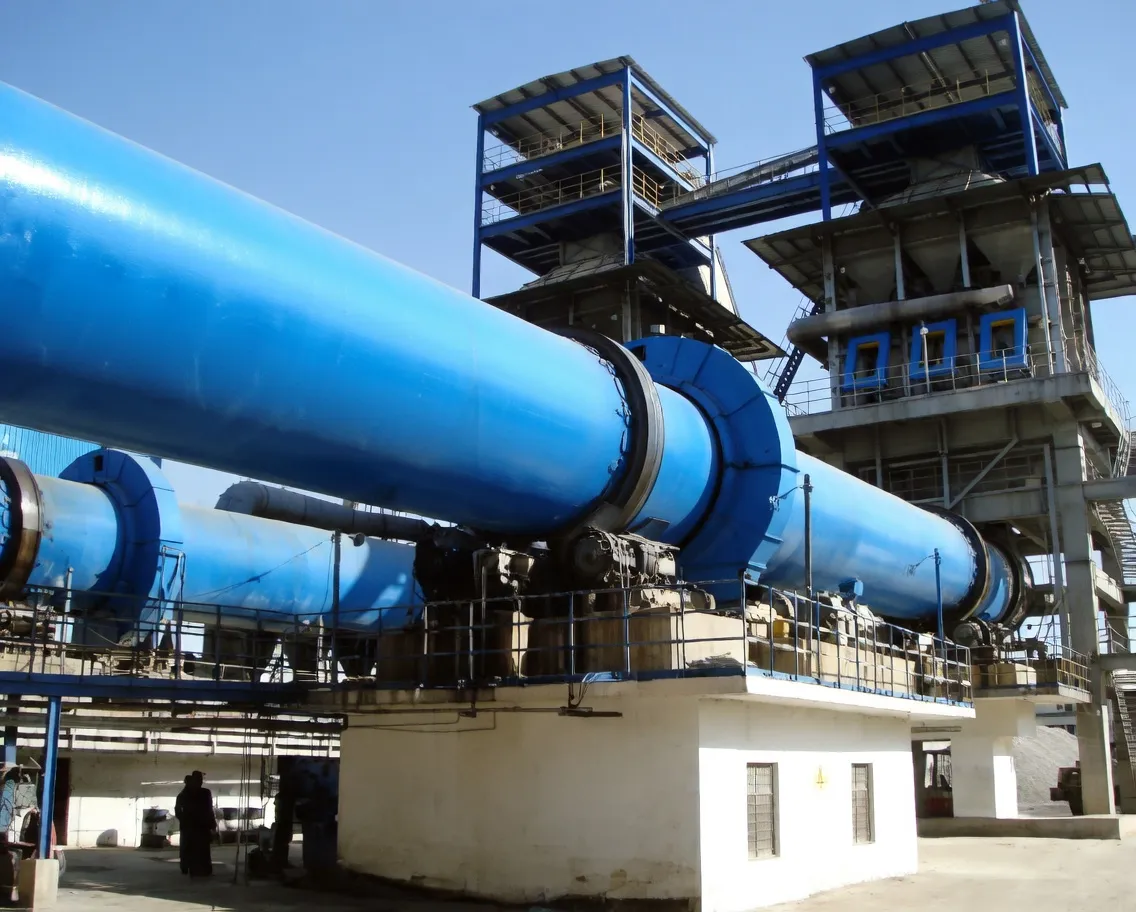
Frequently Asked Questions: QD Bushings for Cement Kiln Drive Systems in the UK
Need Heavy-Duty QD Bushings for a Cement Rotary Kiln Drive in the UK?
Standard and custom sizes available. Ductile iron and steel grades. Full material traceability. Engineering support on sizing and material selection. Fast delivery to all UK sites.
edit by gzl