
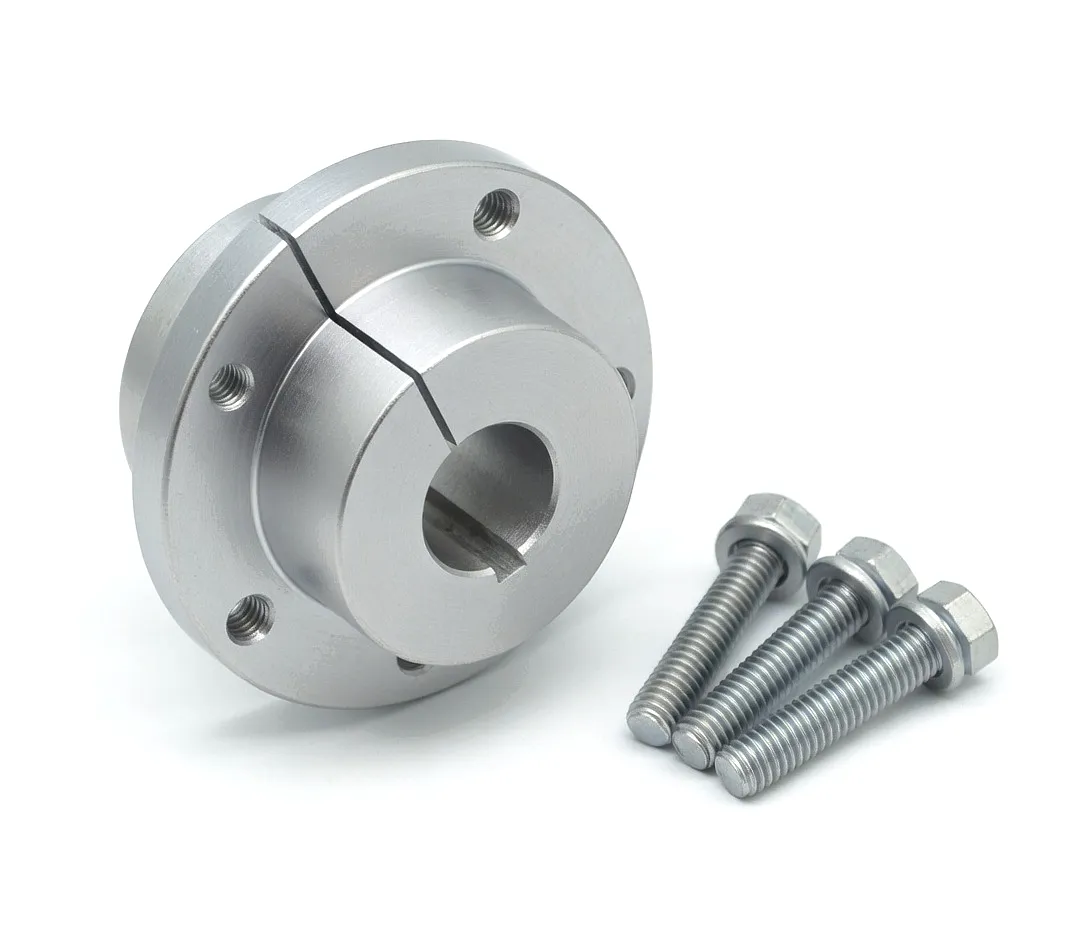
 Modern multi-megawatt wind turbines rated between 2 MW and 10 MW depend on two mission-critical drivetrains to capture energy efficiently and survive storm loads: the yaw system, which swings the nacelle into the wind, and the pitch system, which rotates each blade to regulate rotor speed and mechanical stress. Sitting at the heart of both drives are qd bushings — deceptively simple keyless interfaces that lock gearbox output shafts to the drive pinions meshing with the yaw slewing ring or the pitch blade bearing. For offshore platforms pounded by North Sea salt spray, onshore clusters scattered across the Scottish Highlands, and repowering campaigns throughout Yorkshire and the Midlands, qd bushings from Ever Power have become a trusted interface for UK wind developers, O&M contractors, and OEM drivetrain integrators.
Operating temperatures swing from −40 °C on winter mornings to +60 °C inside a sun-baked nacelle, vibration is relentless, and service technicians work suspended hundreds of metres above ground on the blade itself. Every fastening component must be serviceable, reliable, and vibration-resistant. This is precisely where qd bushings earn their place in the drivetrain bill of materials.

Need a drivetrain interface you can actually service at 120 m up?
Share your torque, shaft, and environmental data — our engineering desk replies within one UK business day with drawings, materials, and pricing.
Why Wind OEMs Specify These QD Bushings
Six engineering properties that matter when the gearbox sits 120 metres up and the nearest crane costs £8,000 per day.
Tower-Top Installation
Split-taper design lets qd bushings be mounted or removed using hand tools inside the nacelle — no puller presses, no heat shrinking, no crane mobilisation for routine swaps.
Arctic-to-Desert Range
Rated from −40 °C to +120 °C, qd bushings maintain clamping pressure even when thermal cycling wrecks conventional shrink-fit couplings on Shetland or Outer Hebrides sites.
Zero-Fretting Interface
Controlled radial clamping of qd bushings prevents the micro-movement that chews keyways and gearbox output shafts during yaw dwell and pitch emergency stops.
Repeatable Concentricity
Every reinstallation of our qd bushings holds TIR under 0.05 mm, protecting pinion-ring-gear mesh geometry and extending the main slew bearing life on 5 MW-plus platforms.
Corrosion Armour
Zinc-nickel, Geomet, or duplex stainless treatments are standard options, so qd bushings keep threads live after 1,000 hours of ISO 9227 salt spray on offshore installations.
Shock-Load Headroom
Friction-based torque transfer lets qd bushings slip safely under extreme gust-driven pitch braking events rather than shearing keys or cracking hubs.
How the Interface Works Inside a 5 MW Nacelle
Mechanical Principle
A tapered inner sleeve and a split outer flange are drawn together by axial cap screws. As the screws tighten, the taper converts axial force into radial pressure, generating a purely frictional grip on the gearbox output shaft. The pinion bore is clamped to the bushing outer diameter through the same action, so torque travels from shaft to pinion without any keyway stress riser.
That friction-only path is why qd bushings survive thousands of yaw reversals per year without loosening on turbines like Vestas V150, Siemens Gamesa SG 5.0-145, or GE Cypress 5.3-158.
Materials & Treatments
Standard qd bushings are machined from EN 1.7225 (42CrMo4) alloy steel, hardened and tempered to 28–32 HRC for the body and through-hardened 42–46 HRC on the taper. For offshore service we supply duplex stainless 1.4462 or 17-4 PH with Xylan 1052 overcoat.
Cap screws are grade 12.9 with zinc-nickel plating as default; grade A4-80 austenitic stainless is available for sites with hydrogen-embrittlement concerns, meaning every batch of our qd bushings leaves the factory with fasteners matched to the deployment zone.
Wind-Duty QD Bushings — Performance Parameters
Typical specifications for the yaw-and-pitch product family; values are tuned to the most common UK turbine platforms and can be customised on request.
| Parameter | Yaw-Duty Range | Pitch-Duty Range | Standard |
|---|---|---|---|
| Bore Diameter | 35 – 110 mm | 28 – 75 mm | ISO 286 h6 |
| Transmissible Torque | 2,400 – 18,000 Nm | 1,100 – 8,500 Nm | μ = 0.12 |
| Body Material | 42CrMo4 / 1.4462 | 42CrMo4 / 17-4 PH | EN 10083-3 |
| Surface Treatment | Zn-Ni 8 μm / Geomet 321 | Dacromet 500 / Xylan | ISO 9227 ≥ 1,000 h |
| Operating Temp. | −40 °C to +120 °C | −40 °C to +120 °C | IEC 61400-1 Class IA |
| Concentricity (TIR) | ≤ 0.04 mm | ≤ 0.05 mm | DIN ISO 1101 |
| Cap-Screw Grade | 12.9 Zn-Ni | 12.9 or A4-80 | ISO 898-1 |
| Design Life | 20 yr / 10⁸ cycles | 20 yr / 2×10⁸ cycles | DNV-ST-0361 |
Application Scenarios Across the Turbine
What UK Wind Professionals Say
We asked three suppliers for a duplex-stainless solution. Only Ever Power came back with finite-element creep data for −40 °C service. The qd bushings have been on our Shetland site for 26 months — not a single re-torque call so far.
Our pitch retrofit engineering team needed an interface we could install inside the hub without removing the blade. Ever Power supplied a split-collar variant of their qd bushings and revised the drawings inside 48 hours. That level of responsiveness is rare.
We run a lean O&M operation covering 220 turbines from Cornwall to Northumberland. Stocking one family of qd bushings across three OEM platforms cut our spares inventory by 37 %. The documentation package is the best I have handled in fifteen years.
Dedicated Support for the United Kingdom Wind Sector
Britain reached 30.6 GW of installed wind capacity in 2025, with Scotland alone responsible for roughly a third of that figure. Operators from Grimsby to Glasgow need components that arrive inside DDP Felixstowe, Hull, or Aberdeen with UKCA-compliant paperwork.
UK Warehouse Stock
Most common yaw-and-pitch qd bushings ship from a bonded warehouse in Birmingham within 48 hours — no sea freight wait for emergency pinion swaps.
UKCA + DNV Docs
Every shipment includes mill certs, DNV-compliant test data, and UKCA conformity statements accepted by HSE auditors at Hornsea, Walney, and Beatrice.
Sterling Pricing
Quotes issued in GBP with fixed currency for 90 days, removing FX noise from your yaw-and-pitch capital budget forecasts.
Custom QD Bushings Engineered Around Your Turbine
Our 26,000 m² facility runs dedicated CNC turning cells, induction hardening lines, and DNV-supervised fatigue rigs. Every pair of qd bushings can be tailored around your exact bore, taper geometry, keyway cut, flange drilling pattern, and surface-finish preference — and we guarantee dimensional traceability from billet heat number to final torque test.
Whether you are prototyping a 15 MW offshore platform or maintaining a fleet of 1.5 MW turbines in Powys, our engineering team delivers detailed 2D/3D drawings, FEA reports, and PPAP-grade documentation inside 72 hours of a sealed specification.
Customisation Menu
Wind Drivetrain Interface FAQ
Where can I buy offshore-grade QD bushings quickly in the UK?
▾
How much does a yaw-drive QD bushing cost for a 5 MW turbine?
▾
Which supplier offers the best turnaround for pitch-system QD bushings?
▾
What torque rating do I need for a Vestas V112 yaw-drive bushing replacement?
▾
When should I replace QD bushings on an offshore wind turbine in the North Sea?
▾
Why do UK offshore operators prefer keyless bushings over shrink-fit couplings?
▾
Which certifications should a pitch-system bushing supplier provide to a British wind farm?
▾
How do you request a price quote for custom wind-turbine QD bushings from Scotland?
▾
Ready to spec the right interface for your turbine?
Our British-standards engineering desk replies within one working day — drawings, material options, and GBP pricing included.
edit by gzl