
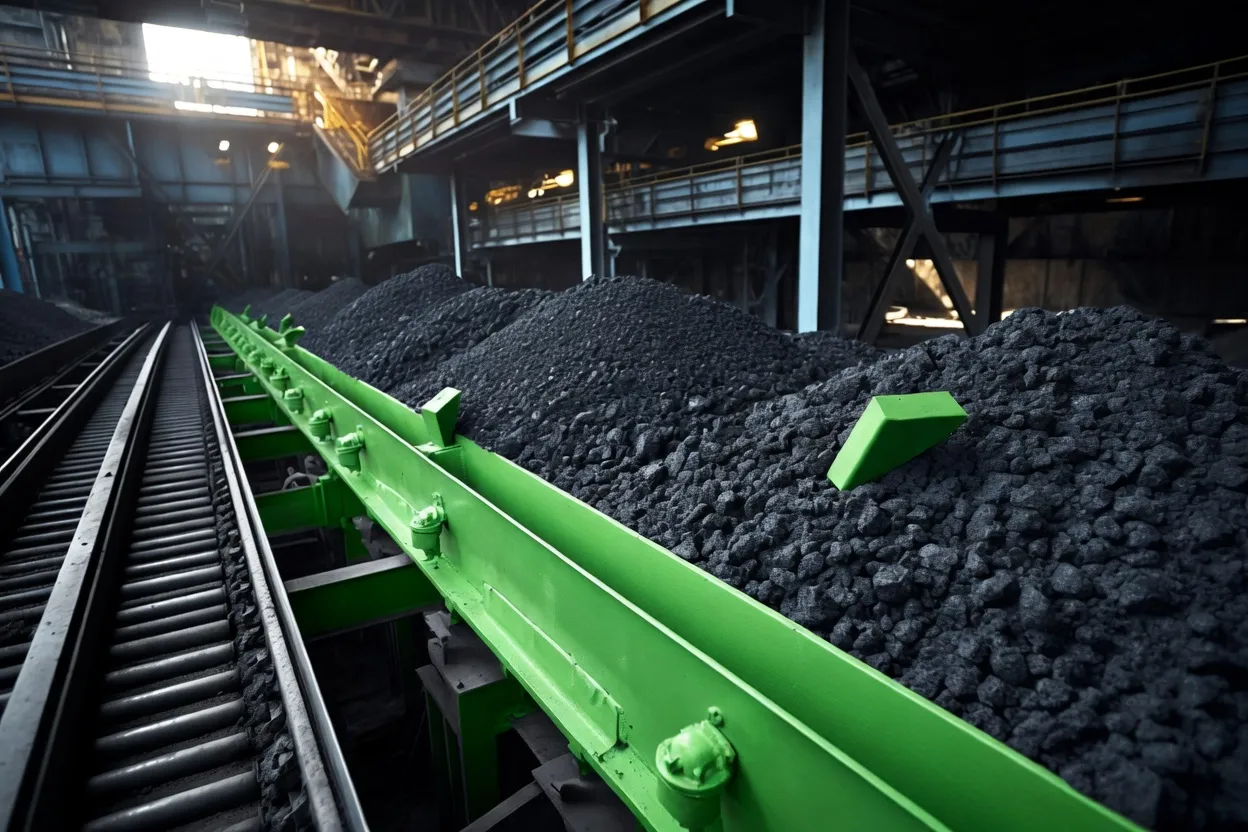
 Mining operations across the United Kingdom depend on conveyor belt systems that run continuously, shifting hundreds of tonnes of raw ore, coal, and aggregate every hour. The reliability of these systems often hinges on the mechanical integrity of individual drive components — and among those components, QD bushings occupy a position of quietly critical importance. Whether it is a 2,400 mm wide main haulage belt running 400 metres underground in a South Wales coal operation, or a compact 750 mm discharge belt serving a Derbyshire limestone crusher, QD bushings provide the secure, tapered interference-fit connection between drive pulleys, sheaves, and sprockets on the transmission shaft.
The letters QD stand for Quick Detach — a design philosophy that became an engineering standard because of a fundamental reality every mine maintenance manager understands: when a conveyor stops, production stops entirely. Downtime costs in UK mining and quarrying operations can reach thousands of pounds per hour. Fast, reliable component installation and replacement is not a nice-to-have — it is a hard operational requirement. QD bushings are engineered to meet that requirement, combining a split-taper bore-and-hub mechanism that locks components onto shafts under precisely controlled torque, and releases them with equal speed whenever maintenance demands access.
This guide draws on over 18 years of hands-on application engineering experience across mining conveyor drive systems in the United Kingdom and Europe. It covers the technical principles behind QD bushings, the materials appropriate for demanding underground conditions, specific application scenarios from UK mining sub-sectors, and the performance data procurement engineers need when evaluating suppliers for their conveyor maintenance programmes.
Size 3535 QD bushings mounted on the head drive drum of a 1,200 mm haulage conveyor. C45 steel with zinc phosphate corrosion protection.
📩 Request a Free Engineering Quote
Response within 24 hours | [email protected]
Engineering Principles, Materials, and Design: What Makes a QD Bushing Work
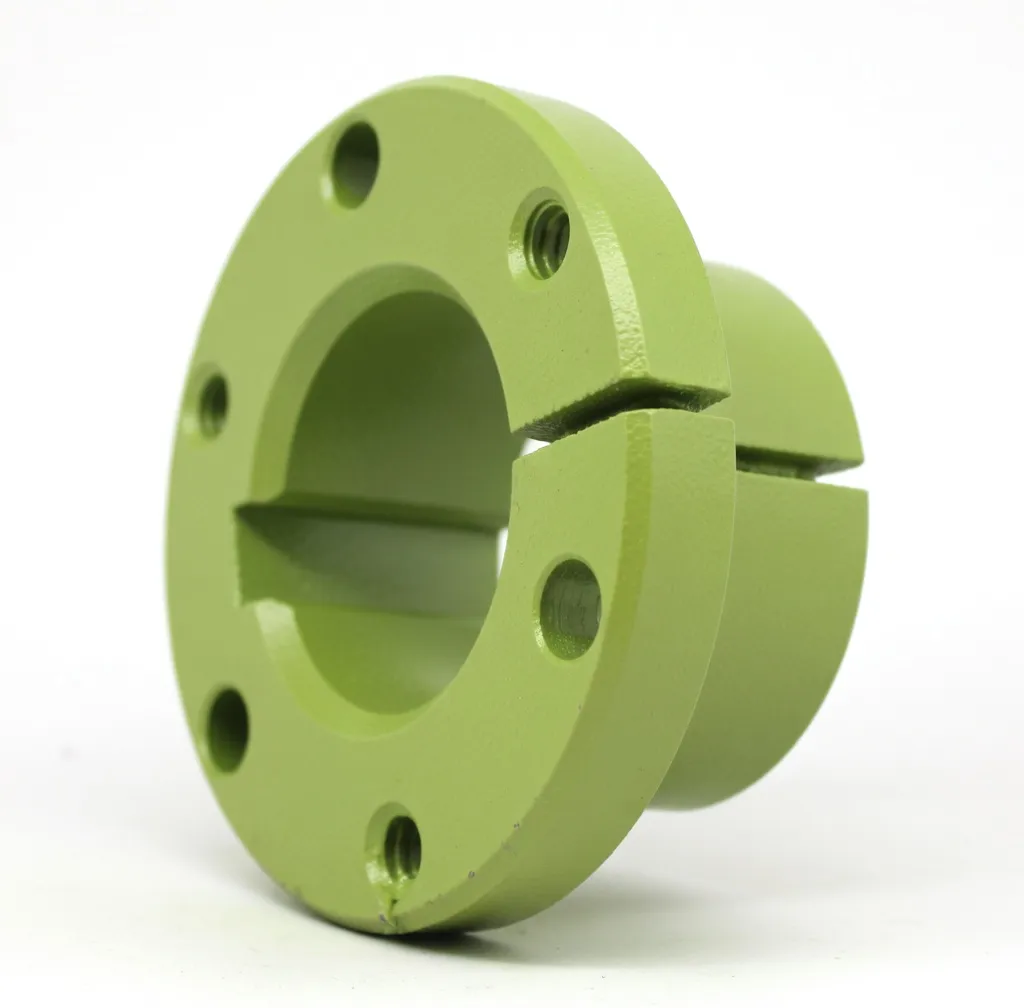 A QD bushing is a precision-machined, longitudinally split taper hub. Its purpose is to mount rotating machine elements — pulleys, sheaves, sprockets, and couplings — onto drive shafts without requiring individually custom-bored hubs for every shaft diameter encountered on site. The mechanism relies on geometry rather than adhesives or welds: the external taper on the bushing mates with a matching internal taper bored into the hub of the driven component. As the operator tightens the cap screws in a star pattern to the manufacturer-specified torque, the split in the bushing body allows the bore to contract radially inward, generating a high-pressure interference fit against the shaft surface. Depending on bushing size, this produces a shaft-hub connection capable of transmitting torques from approximately 180 Nm on the smallest 1008 size up to 8,200 Nm or beyond on the 4040 size — without any shaft modification other than the standard keyway.
Material selection is where the application engineering becomes genuinely consequential in mining environments. Standard off-the-shelf QD bushings are produced in ASTM A48 Class 30 grey cast iron, which performs well under the compressive and vibration-dampening demands of most industrial conveyor applications. However, underground mines — particularly those dealing with acid mine drainage from exposed mineral seams, high-humidity return airways, or direct water ingress in poorly drained headings — impose corrosion conditions that grey cast iron alone cannot withstand over a full maintenance interval. For these applications, ductile iron (ASTM A536 Grade 65-45-12) offers a significant step up in toughness and corrosion resistance. Where the shaft loading involves impact as well as steady torque — as on a crusher discharge belt with large rock fragments dropping onto the belt directly above the drive drum — the higher tensile strength of C45 carbon steel (tensile strength approximately 700 MPa compared to 200 MPa for grey cast iron) provides the fracture resistance margin that mine engineers specify as a design requirement. Stainless steel variants in AISI 304 and AISI 316 are reserved for the most aggressive environments: coastal aggregate terminal conveyors exposed to saline Atlantic air, pump-water return belts running through flooded areas, or applications where cleaning with acidic descalants is a regular maintenance practice.
The removal process is an integral part of the engineering design, not an afterthought. Dedicated jack-screw holes — separate from the mounting screw holes — are threaded into the bushing flange face. Turning the removal screws into these holes forces the bushing axially outward along its taper, breaking the interference fit progressively and cleanly without requiring hydraulic pullers, cutting torches, or any force that would damage the shaft. A skilled maintenance technician working in the confined access of an underground roadway can complete a full QD bushing extraction and reinstallation on a conveyor drive pulley in under 25 minutes with standard hand tools — a critical difference from press-fit or welded hub configurations where the same task requires a mobile crane, an engineering workshop, and an overnight production shutdown.
Bore tolerances on QD bushings are held to H7 on the shaft fit, with taper geometry machined to within ±0.005 mm to guarantee correct load distribution across the full contact length. This manufacturing precision is what separates a correctly functioning tapered hub from a loose, fretting assembly — and it is the reason that purchasing QD bushings purely on price without examining tolerance specifications is a false economy for any mine operator dealing with high-value shafts.
Technical Specifications: QD Bushings for Mining Conveyor Drive Pulleys
* Torque values are nominal at standard assembly torque per manufacturer data sheet. Custom bore, dual-keyway, and flanged variants available on request.
Why UK Mining Engineers Specify QD Bushings Over Conventional Hub Connections
Mine maintenance managers across England, Scotland, and Wales have long recognised that the hub connection technology on their conveyor drive pulleys directly determines the frequency of planned maintenance interventions and the severity of unplanned breakdowns. Conventional press-fit hubs require hydraulic presses for both installation and removal — equipment that has no practical home in a narrow underground roadway. Welded-on hubs remove adjustability entirely, turning any shaft replacement into a full fabrication exercise requiring a certified welder, a machine shop, and days of downtime. Plain keyed bushings without taper engagement develop fretting corrosion and mechanical wear at the shaft interface within months under the cyclic loading of a loaded belt start, causing shaft damage that forces replacements far earlier than the shaft design life would suggest. QD bushings address each of these failure modes with a single engineered solution.
Rapid Maintenance Turnaround
A QD bushing removal and reinstallation on a live conveyor drive pulley can be completed in under 30 minutes by a trained technician with standard hand tools. Against the 6–12 hours typically required for press-fit or welded alternatives, this difference translates directly into recovered production tonnes per shift. On high-tonnage UK trunk conveyors running at full capacity, that recovery can represent tens of thousands of pounds per maintenance event.
Zero Shaft Surface Damage
The tapered interference fit distributes clamping force uniformly across the entire shaft contact zone, eliminating the stress concentration points that cause fretting and galling under the cyclic loading of conveyor belt starts. Shaft surfaces remain serviceable through their full design life — and through multiple successive QD bushing installations — without developing the groove wear patterns that ultimately necessitate expensive shaft replacements on conventionally keyed drive pulleys.
Axial Position Adjustability
Before final torquing, a QD bushing can be positioned freely along the shaft to achieve precise belt tracking alignment. This flexibility is especially valuable during conveyor commissioning on new mine development projects in the UK, where conveyor geometry is still being refined to accommodate evolving access roadway profiles and drive station layouts. No shaft rework or re-machining is needed to reposition the drive pulley.
Shock Load Performance
Mining conveyors experience significant shock loads: full-load belt starts from standstill, large rock impacts on the carry strand, and tension wave propagation during emergency stops. The taper geometry of a correctly installed QD bushing responds to shock torque by momentarily increasing the radial interference rather than releasing it, maintaining connection integrity at precisely the moments when shaft-hub slippage is most likely to occur with alternative hub types.
UK-Optimised Corrosion Resistance
British mining environments present persistent corrosion challenges that are distinct from the drier climates for which many industrial component specifications were originally developed. From the damp underground workings of Welsh coal seams to the exposed conveyors of Scottish Highland quarries, our QD bushings are available with zinc phosphate treatment, electrolytic zinc plating, and full AISI 316 stainless steel construction to match each site’s corrosion exposure profile.
Whole-Life Cost Reduction
When shaft service life, labour hours, crane hire, engineering contractor costs, and production losses from unplanned stoppages are all factored into a 5-year total cost of ownership model, QD bushings consistently outperform alternative hub connection technologies. UK mining operations that have standardised their conveyor drive systems on QD bushings report maintenance cost reductions of 25–40% compared to their previous hub connection methods — a figure that comfortably offsets any premium over lowest-cost catalogue alternatives.
QD Bushings Across the Mining Conveyor System: Four Key Application Zones
A modern UK hard rock quarry or underground coal mine contains multiple conveyor sub-systems, each presenting a distinct set of mechanical demands on the QD bushing specification. Drive power, shaft diameter, belt width, access constraints, and corrosion exposure all vary considerably between a run-of-mine feeder belt at surface and a main haulage incline running deep underground. The following four application zones represent the most common scenarios encountered in British mining and aggregate processing operations.
Customer Success Story
A Real Outcome from a UK Hard Rock Quarrying Operation
CLIENT
Caledonian Aggregates Ltd.
Perthshire, Scotland, UK
KEY RESULTS
✅ Downtime reduced by 62%
✅ Annual shaft cost saved: £18,400
✅ Zero failures over 36 months
✅ ROI within 8 months
The Challenge
Caledonian Aggregates operates a hard rock granite quarry in Perthshire producing approximately 1.2 million tonnes of aggregate per year. Their primary haulage conveyor — a 450-metre incline belt running at 3.5 m/s and driven by a 500 kW head drive station — was equipped with welded-hub pulleys throughout. Every planned pulley change required a mobile crane, a full overnight production shutdown, and specialist shaft-welding contractors called in from Dundee. Over three years the operation had suffered four unplanned drive pulley failures, accumulating an estimated £78,000 in lost production and emergency repair costs, not counting the knock-on effects on the downstream screening and washing plants that relied on consistent feed from the incline belt.
The Solution
Following a detailed site survey by our application engineering team — which included shaft diameter measurements, torque calculations for the installed drive, and an assessment of the underground atmospheric conditions — we specified a retrofit solution using Size 3535 QD bushings in C45 steel with zinc phosphate corrosion protection, matched to the existing 110 mm drive shaft diameter. New pulley hubs were precision-machined at a Dundee engineering works with the correct QD taper bore drawing supplied by our technical team. The complete conversion was executed during a single planned 48-hour maintenance window, with our engineer on-site for commissioning and installation verification.
The Outcome
In the 36 months following installation, Caledonian Aggregates recorded zero bushing-related failures on the haulage incline system. The maintenance team completed the first 6-month scheduled pulley inspection in under two hours — down from the previous 14-hour crane-assisted process. The operations manager reported that standardising on QD bushings had changed the maintenance management model for the whole site, shifting the conveyor drive systems from reactive emergency repair to predictive scheduled maintenance. Overall quarry site productivity improved by an estimated 8% in the first full year following the changeover.
What UK Mining & Quarry Operators Say
“
We converted all six surface conveyor drive stations at our Derbyshire limestone quarry to QD bushings three years ago. The time saving on routine inspections alone has been remarkable — tasks that once occupied a full maintenance crew for a day now wrap up before midday. The technical support during specification selection was thorough and genuinely engineering-led, not just a catalogue recommendation.
James Hartley
Maintenance Manager, Derbyshire Limestone Quarries Ltd, East Midlands, UK
“
Our underground gate belt drive pulleys in South Wales had persistent shaft wear from fretting corrosion — we were replacing shafts every 14 months. After switching to QD bushings with the recommended phosphate coating, we have not had a single shaft replacement in over two years. The wet conditions underground haven’t touched them. We have been re-ordering without question ever since.
Rhys Morgan
Head of Engineering, South Wales Coal Operations Ltd, Wales, UK
“
The custom stainless steel 316 QD bushings we needed for our coastal aggregate terminal in Aberdeen were outside what standard catalogue suppliers could offer. This team turned around a custom specification in three days and delivered on schedule. Two North Sea winters later, they are performing exactly as specified with no visible corrosion at any of the sea-facing conveyor drive stations.
Angus Mackintosh
Plant Director, Aberdeen Coastal Aggregates Terminal, Scotland, UK
Manufacturing Excellence & Custom Engineering
Precision QD Bushing Manufacturing for UK Mining Operations — Standard Catalogue and Fully Bespoke
🏭 CNC Precision Manufacturing
All QD bushings are produced on multi-axis CNC turning centres, with taper geometry held to ±0.005 mm tolerance across the full bore length. Dimensional verification uses coordinate measuring machines (CMM) on every production batch, and material hardness certification is provided to ISO 6506 for all steel and iron grades. Surface roughness on taper and bore contact faces is maintained to Ra 0.8 µm, ensuring consistent interference generation at assembly torque.
🔩 Full Customisation Service
Our engineering team works directly with UK mine procurement managers and OEM conveyor manufacturers to develop bespoke QD bushing solutions that catalogue suppliers cannot provide. Custom options include non-standard bore sizes and tolerances, dual-keyway configurations, extended hub lengths, flanged and collared variants, custom surface treatments, and complete pulley-bushing matched assembly packages. Minimum order quantity from 10 pieces for custom projects, with drawing and specification review included at no additional engineering charge.
📋 Application Engineering Consultation
With over 18 years of combined application engineering depth in power transmission for mining and bulk material handling, our technical team provides free bushing selection consultations, site-specific corrosion environment assessments, and drive torque calculation reviews for UK mining projects. Whether specifying for a new mine development, planning a conveyor upgrade, or troubleshooting a recurring drive failure, we provide the engineering rigour that purchasing decisions in this industry genuinely require — not just a size recommendation from an online catalogue.
🚚 UK Supply and Emergency Delivery
Standard catalogue QD bushings are available for express delivery to any location across England, Scotland, Wales, and Northern Ireland. For critical mine conveyor failures where every hour of downtime carries significant production cost, emergency supply from stock can typically be dispatched within 24 hours of order confirmation. We maintain freight partnerships with express carriers that understand the time-critical nature of mining production emergencies, and we are familiar with the logistics of delivering to remote Scottish highland and Welsh valley mining sites.
Get a Quote — [email protected]
UK mining procurement teams welcome | Custom specifications | Technical drawings provided
Supplying QD Bushings to the UK Mining and Quarrying Sector
The United Kingdom’s mining and quarrying sector employs tens of thousands of workers and produces over 200 million tonnes of aggregates, coal, industrial minerals, and metals annually. Hard rock quarrying concentrated in Cornwall, the Peak District, the Yorkshire Dales, and the Scottish Highlands; underground coal and coalbed methane extraction in South Wales and South Yorkshire; potash mining in North Yorkshire; and aggregate processing facilities distributed across every region of England, Scotland, and Northern Ireland — each of these sub-sectors operates conveyor belt systems that depend on reliable, correctly specified drive components. QD bushings are a common denominator across all of them.
In Scotland and Northern England, where quarry and mining sites are often exposed to high-moisture Atlantic weather systems, corrosion-protected QD bushings are the baseline specification for any new conveyor installation rather than an optional upgrade. The interaction between persistent rainfall, acidic upland soils, and the freeze-thaw cycles common at Scottish Highland elevations creates a corrosion environment that standard uncoated cast iron components cannot survive for a full 12-month maintenance interval. Our zinc-phosphate and electrolytic zinc-plated variants were validated specifically against UK-representative atmospheric corrosion conditions prior to their introduction to the catalogue, giving procurement managers confidence that the protection specification will hold up through a full operational year in a Scottish or Northern English site.
For quarry operators in the East Midlands, South West England, and Wales — where limestone, sandstone, and granite operations represent the core commercial activity — our standard grey cast iron QD bushings have an established supply record covering the most common UK-prevalent conveyor shaft diameter range from 30 mm to 100 mm. Sizes 1610, 2012, 2517, 3030, and 3535 are held in stock and available for standard delivery nationally.
UK mine and quarry operators are welcome to contact our technical sales team for a no-obligation consultation or a tailored supply quotation. We are familiar with the maintenance and engineering management requirements under the UK Mines Regulations 2014 and the Health and Safety Executive guidance applicable to conveyor belt mechanical components, and our products are specified to support engineering compliance documentation for planned inspection regimes.
Frequently Asked Questions
Ready to Upgrade Your Mine Conveyor Drive System?
Talk to our UK mining application engineering team. We provide technical consultations, custom specifications, and rapid supply for all QD bushing requirements — from single emergency replacement parts to full mine-wide supply and maintenance contracts.
📩 Get a Quote — Contact Us Now
[email protected] | Response within 24 hours | UK Mining & Quarrying Specialists
edit by gzl