
 Port bulk cargo terminals are some of the most mechanically severe operating environments in modern industry. The bucket wheel reclaimer — the enormous, sweeping machine that excavates and relocates millions of tonnes of iron ore, coal, and grain each season — subjects every component in its drivetrain to a relentless combination of extreme torque, shock loading, directional reversals, and tidal salt air corrosion. When a reclaimer halts unexpectedly, the consequences ripple outward immediately: vessel unloading schedules collapse, demurrage charges accumulate at rates that can exceed £25,000 per day, and port throughput figures suffer damage that takes weeks to recover from. Against this backdrop, the QD bushing — a component that costs a fraction of a percent of the machine’s total capital value — occupies a disproportionately critical position in the drivetrain reliability picture.
QD bushings, short for Quick Detach bushings, serve as the precision mechanical interface between rotating shafts and the sprockets, sheaves, coupling flanges, and chain drives that transmit power throughout the reclaimer. In the salt-laden, vibration-rich environment of a British coastal bulk terminal — Immingham, Tilbury, Port of Tyne, Grimsby, Teesport, or any of the major bulk handling ports operating around the UK coastline — standard fastening components corrode, fret, and fail with dispiriting frequency. Properly specified marine-grade QD bushings change that equation completely, extending maintenance intervals from months to years and eliminating the shaft rework costs that inflate whole-life ownership figures far beyond the initial component budget.
This guide examines every practical dimension of QD bushing application in bucket wheel reclaimers — from bore sizing for outputs exceeding 300,000 Nm to corrosion protection strategies developed specifically for North Sea tidal-air environments — drawing on 18 years of hands-on application engineering experience across UK and European port logistics sites.

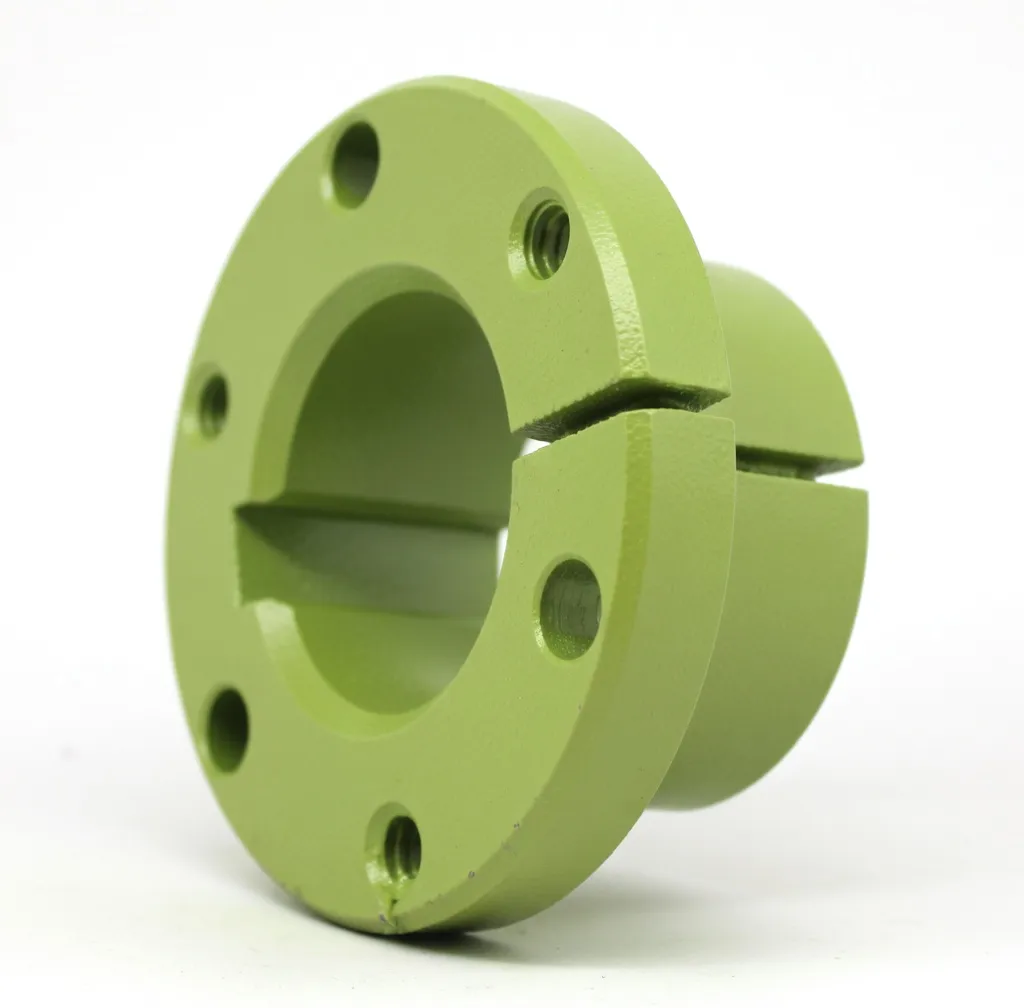
Marine-grade hot-dip galvanised and 316L stainless QD bushings — engineered for bucket wheel reclaimer drivetrain connections in UK coastal port environments
What Makes QD Bushings the Correct Choice for Heavy Port Drivetrain Applications?
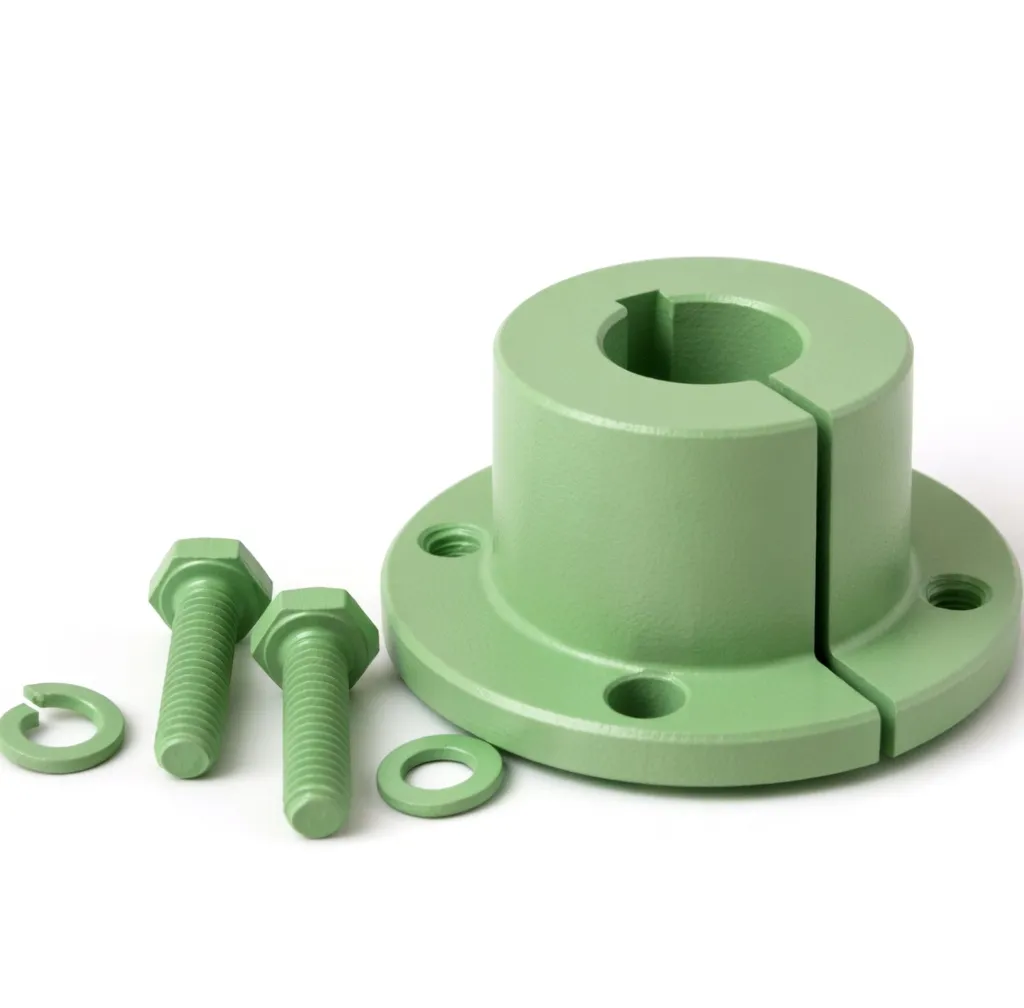 A QD bushing is a split-hub, tapered-bore sleeve precision-machined to mate with a matching internal taper in a sprocket hub, sheave, or coupling flange. The “Quick Detach” name captures what distinguishes these components in field maintenance situations: removal requires no external puller tool. The same cap screws that secure the bushing during operation are repositioned into threaded extraction holes, where tightening them jacks the taper free with clean mechanical advantage. In a port environment where maintenance access is often restricted by the machine’s physical dimensions, where time pressure is intense during a vessel’s unloading window, and where the nearest workshop may be several kilometres from the quayside, this extraction simplicity is not a convenience feature — it is a genuine operational advantage worth specifying for on its own merits.
The taper geometry — standardised at a 4-degree half-angle, producing an 8-degree included angle — delivers performance that exceeds what the straightforward geometry suggests. As the mounting cap screws are torqued, the bushing is drawn into the hub taper, generating radial clamping pressure that is distributed uniformly across the full circumference of the shaft contact zone. This 360-degree engagement carries the operational torque primarily through friction rather than through the keyway, which functions as a rotation-stop and emergency backup rather than the primary load carrier. The result is that the shaft surface experiences compressive circumferential loading rather than the localised shear stresses associated with keyway-dominant connections. In a bucket wheel reclaimer, where the gearbox output stage regularly delivers 200,000 to 380,000 Nm to the wheel shaft, this distributed load geometry is the difference between a connection that provides five or more years of reliable service and one that generates fretting damage within a single operating season.
One characteristic of QD bushing connections that deserves particular emphasis in the reclaimer context is their behaviour under reversing loads. The bucket wheel’s operational cycle includes regular transitions between stacking mode (material deposited on the stockpile) and reclaiming mode (material excavated from the stockpile face), each transition imposing a torque reversal on the drivetrain. Under cyclic reversing loads, connections that rely primarily on friction from interference fits or setscrews exhibit progressive microslip — a cumulative angular displacement that gradually destroys the shaft surface through fretting oxidation. QD bushings, with their taper engagement reinforced by a keyway, resist this microslip failure mode far more effectively, maintaining their grip integrity across thousands of mode-transition cycles over a multi-year service life.
Technical Specifications: QD Bushings for Bucket Wheel Reclaimer Applications
| Parameter | Specification | Reclaimer Application Note |
|---|---|---|
| Taper Angle | 4° (8° included) | Self-locking geometry under sustained & shock torque loads |
| Bore Range | 12.7 mm – 152.4 mm | Covers main wheel shaft to auxiliary conveyor drives |
| Max. Torque Capacity | Up to 380,000 Nm | Suitable for primary gearbox output stage connections |
| Standard Material | Grey cast iron GG25 / Ductile iron GGG50 | Suitable for enclosed or inland installations only |
| Marine Grade Options | 316L Stainless Steel / Hot-dip galvanised ductile iron | Recommended for all UK coastal port installations |
| Salt Spray Resistance | 500 h (galvanised) / 1,000+ h (316L SS) | Per ISO 9227 neutral salt spray — batch-tested before shipment |
| Keyway Configuration | Single keyway / Double keyway / Splined bore | Double keyway for reversing & shock-load drive positions |
| Operating Temperature | -40°C to +200°C | Full year-round UK outdoor operation including winter extremes |
| Bore Tolerance | H7 fit (standard) / H6 available for precision applications | H7 adequate for reclaimer duty; H6 for precision gearbox shafts |
| Bolt Pattern Standard | ANSI B4.1 compatible / Custom DIN flanges available | OEM retrofit compatibility for existing hub assemblies |
Seven Proven Advantages of QD Bushings in Port Reclaimer Drivetrains
No-Puller Field Removal
When a worn sprocket must be swapped on the slewing drive at two in the morning during a vessel unloading window, there is no time for external pullers or improvised extraction rigs. QD bushings release using the same cap screws that installed them — repositioned into threaded extraction holes — reducing a component exchange that might previously take half a shift to under thirty minutes. For UK port maintenance teams working within tight shift change windows, this operational benefit alone typically justifies the specification decision at the component procurement level.
Salt-Spray Corrosion Resistance
British coastal port terminals — particularly those on the east coast exposed to North Sea tidal air — subject external drivetrain components to electrochemical corrosion rates that consume standard grey cast iron hardware within a single operating season. Marine-grade galvanised ductile iron QD bushings provide 500+ hours of ISO 9227-compliant salt spray resistance; 316L stainless variants extend that to over 1,000 hours. Over a five-year operational window, that difference translates to three or four fewer component replacement cycles per drive position, with corresponding reductions in crane hire, labour cost, and machine downtime exposure at critical throughput periods.
Extreme Torque Transmission Capacity
Bucket wheel gearboxes output torques that overwhelm conventional setscrew, clamp collar, or interference-only shaft connections when operating under sustained load or during shock events. The QD bushing’s tapered interference fit generates clamping pressures distributed across the complete bore contact area, achieving torque capacities up to 380,000 Nm in the largest bore sizes. At the main wheel shaft — where output torques routinely exceed 200,000 Nm in machines handling dense ores — this circumferential grip is not a safety margin. It is the fundamental mechanism that keeps the connection intact across years of continuous operational duty.
Self-Centering Precision Geometry
The 4-degree taper seats concentrically on the shaft regardless of minor surface variation, maintaining geometric alignment that protects gearbox bearings and chain mesh downstream from the connection point. In a reclaimer where the cantilevered bucket wheel imposes variable bending moments on the main shaft during the excavation cycle, consistent concentricity is not merely a precision engineering preference — it directly determines bearing life expectancy in the primary gearbox. An improperly centred connection introduces parasitic radial loads that manifest as premature bearing failure, with replacement costs and downtime exposure many times greater than the original bushing specification cost.
Rationalised Spare Parts Inventory
A UK port terminal operating multiple reclaimers of the same model family can standardise on a small selection of QD bushing sizes covering all drive positions across the entire fleet. This inventory rationalisation reduces the capital tied up in spares holdings, simplifies procurement and inspection record-keeping, and eliminates the risk of a maintenance shutdown being extended because a specific interference-fit collar for a particular shaft diameter is out of stock. For port maintenance managers responsible for both cost control and uptime targets, spare parts standardisation is consistently one of the highest-leverage improvements available within the existing capital budget.
Reversing-Load Tolerance Without Fretting
Bucket wheel reclaimers regularly reverse slewing direction and cycle between stacking and reclaiming modes, each transition imposing a torque reversal on every drivetrain connection. Under cyclic reversals, purely friction-based connections exhibit progressive microslip — a cumulative angular displacement that destroys the shaft surface through fretting oxidation. QD bushing connections resist this failure mode through the combination of deep taper engagement and keyway backup, maintaining their holding torque across thousands of reversal cycles. Field experience from UK iron ore terminals confirms that properly installed marine-grade QD bushings remain free of fretting product at the shaft interface through inspection intervals of 24 months or longer under normal operational conditions.
Zero Shaft Surface Damage on Extraction
Because QD bushing extraction force is generated through the bushing’s own threaded extraction holes rather than through impact tools, wedges, or improvised levers, the shaft surface experiences no mechanical damage during removal. Protecting the shaft matters enormously in reclaimer applications: a main wheel shaft requiring in-situ rework can take the machine out of service for weeks, with specialist contractor mobilisation and precision grinding costs that can exceed £40,000 on a single repair. Avoiding that risk entirely — across every component replacement cycle throughout the machine’s twenty-year service life — represents a compelling financial case for QD bushing specification that procurement decisions made on unit price alone consistently miss.
Where QD Bushings Are Applied Inside a Bucket Wheel Reclaimer
🔫 Bucket Wheel Main Shaft — Primary Gearbox Interface
The primary gearbox output flange connects to the bucket wheel shaft through a large-bore QD bushing assembly, typically in the 100 to 152 mm bore range. This is the highest-torque position in the entire machine — sustained outputs routinely exceed 200,000 Nm in medium-capacity reclaimers handling iron ore or coal, and peak shock loads during hard material impact can reach 2.5 times the nominal figure. The QD bushing at this interface must maintain grip integrity under both the continuous excavation torque and the transient shock loads generated when a bucket strikes an embedded rock face or compacted ore cluster within the stockpile body.
For this position in UK coastal port terminals, double-keyway bore configurations are recommended as standard rather than optional. The double keyway acts as a mechanical failsafe under the most severe shock events, providing a secondary retention mechanism should the taper friction momentarily experience microslip under an extreme transient load. Marine-grade treatment for main shaft QD bushings typically focuses on the external flange faces and cap screw engagement zones, which accumulate salt-laden condensation most aggressively during the atmospheric temperature cycling of UK coastal weather. Specifying hot-dip galvanised ductile iron as the minimum treatment, with 316L stainless steel preferred for east coast terminals exposed to direct North Sea tidal air, is the accepted practice recommendation from field experience across multiple UK bulk handling sites.
🏗️ Luffing Winch Drive System
The luffing mechanism controls the vertical angle of the reclaimer boom arm, an essential function for adapting to varying stockpile heights as the active face of the pile recedes and grows during operational cycles. The winch drum shaft, connected to its motor-gearbox assembly through a QD-mounted sprocket or flexible coupling, operates intermittently under very high static holding loads — effectively suspending the entire boom structure and its material load between adjustment moves. This static dwell condition imposes a different kind of stress on the QD bushing compared to the rotating torque at the main wheel shaft: the connection must maintain its angular position with absolute zero creep under sustained unidirectional load rather than under cyclic or reversing conditions.
The luffing drive QD bushing is frequently overlooked in port maintenance programmes that focus primarily on the main wheel shaft connection, but it represents a significant risk point if neglected. UK port operators with established condition monitoring programmes typically include luffing drive QD bushing torque checks in their annual statutory outage inspection schedule, verifying cap screw torque values against the manufacturer’s table for the installed bore size and confirming taper contact quality using engineers’ marking compound. Seasonal temperature variation in UK outdoor environments — swings of 30 to 40°C between summer and winter extremes — can cause slow bolt torque relaxation through differential thermal expansion at the steel shaft and cast iron bushing interface, making annual re-torque checks a straightforward preventive measure with disproportionate reliability value.
🔄 Slewing Ring Chain Drive Sprockets
The slewing mechanism — which rotates the entire reclaimer superstructure about the central slew ring to traverse the machine across the stockpile face — typically uses chain-and-sprocket transmissions where QD bushings mount drive sprockets directly to their shaft. This drivetrain position is among the most environmentally exposed on the entire machine: the sprocket housing is rarely fully sealed against atmospheric ingress, chain lubrication residue attracts dust and moisture from the bulk material handling operations, and the combination creates an electrochemical environment that is particularly destructive toward standard cast iron hardware. The corrosion challenge at this location is compounded by galvanic coupling risk — steel chain plates in contact with the cast iron bushing body in the presence of chloride-laden moisture accelerates selective attack at the dissimilar metal interface.
Specifying austenitic 316L stainless steel QD bushings for slewing drive sprocket positions eliminates the galvanic risk entirely and dramatically reduces inspection frequency compared to standard iron units. Field data from UK coal terminals following changeover from standard to stainless QD bushings at slewing drive positions shows inspection intervals extending from quarterly checks to bi-annual reviews, generating measurable savings in inspection labour across a multi-machine fleet. The price premium for stainless is recovered within the first year when the full cost of quarterly inspections — including crane hire for access, labour, and the administration overhead of scheduling and documenting each inspection event — is factored into the comparison.
🚊 Boom Conveyor Drive and Tail Pulleys
The onboard boom conveyor belt — which carries excavated bulk material from the bucket wheel discharge chute up the inclined boom structure to transfer onto the main overland conveyor — requires QD-mounted drive and tail pulleys. In larger reclaimer designs, multiple conveyor drive positions exist on a single machine, and the ability to standardise all of those positions on a single QD bushing bore size is a practical fleet management advantage that deserves deliberate planning during the specification phase. For a UK port terminal maintaining a fleet of three to six reclaimers of matched specification, this standardisation can reduce the unique bushing part numbers held in the spares store from dozens to just three or four line items.
Boom conveyor pulleys present a maintenance access challenge that makes the QD bushing’s no-puller removal characteristic particularly valuable. On many reclaimer boom designs, the tail pulley shaft is located at height, at the far end of the boom arm, with restricted work platform access. Removing a standard press-fit or setscrew-retained pulley hub from this position typically requires either a significant disassembly sequence or working in awkward confined access conditions with heavy-duty tooling. A QD bushing extraction performed with a standard socket set, from the same platform position used for routine greasing checks, represents a qualitative improvement in maintainability that translates to measurable reductions in corrective maintenance duration across the life of the machine.
Customer Success Story: ABP Immingham Bulk Terminal, UK
The Challenge
Immingham’s iron ore reclaimer fleet was experiencing premature gearbox flange fretting and progressive shaft surface damage due to microslip at the bucket wheel main shaft connection. Standard grey iron interference-fit collars were failing within 8 to 14 months, with shaft rework required at each major statutory overhaul. Three reclaimers were affected, and the combined cost of shaft rework alone was running at approximately £52,000 per annual outage cycle. Additionally, the slewing drive sprocket bushings were developing visible red oxide fretting product within six months of installation, requiring out-of-programme inspection visits that each consumed a full maintenance crew day.
The Solution
Following an application engineering consultation with Ever Power, the site specified a complete retrofit of marine-grade hot-dip galvanised QD bushings with double-keyway 120 mm bores across all three reclaimer main shaft interfaces. Slewing drive sprocket positions on all three machines were simultaneously retrofitted with 316L stainless steel QD assemblies matched to the existing sprocket hub bore dimensions. Ever Power provided custom dimensional drawings for compatibility verification before manufacture and supplied material test certificates and ISO 9227 salt spray test data with each delivery. The complete installation was carried out over two scheduled maintenance outages without any additional machine downtime beyond the planned window.
The Result
The 24 months following installation produced zero unplanned drivetrain stoppages attributable to bushing or shaft connection issues across all three machines. Main shaft QD bushings showed no fretting product at the first 18-month inspection, and cap screw torque values remained within 4% of the specified installation torque. Shaft rework costs at the following statutory outage: zero. The slewing drive stainless QD bushings passed a 24-month visual and torque check with no actionable findings. The maintenance engineering team conservatively estimated the total saving across the three-machine fleet, accounting for avoided shaft rework, avoided unplanned inspection visits, and improved outage efficiency, at approximately £61,000 over the 24-month review period.
What Port Engineers Say About Our QD Bushings
We had been fighting shaft fretting on the main wheel drive connection for three consecutive overhaul cycles. Switching to the marine galvanised QD bushing with double keyway bores resolved the problem completely. The 18-month inspection showed no fretting product and no torque relaxation whatsoever. The installation team had all three machines completed in a single extended shift window, which was far quicker than we had anticipated.
James Hartley
Senior Mechanical Engineer — ABP Immingham, UK
As a food-grade grain terminal, we cannot have rust contaminating the product stream. The stainless QD bushings on our boom conveyor drives have remained completely clean through two full winters on the Thames Estuary. The quick-detach feature means we can swap a worn pulley without the overhead gantry crane, which saves us around four hours per conveyor drive change-out compared to what we were doing before.
Sarah Reynolds
Plant Maintenance Manager — Cargill Grain Terminal, Tilbury, UK
We specified the Ever Power QD bushings for our new reclaimer procurement on the strength of the corrosion performance data and the ability to supply custom bore sizes to drawing within a four-week manufacturing lead time. The technical support during the application engineering phase was genuinely impressive — bolt torque recommendations specific to our shaft material, material selection rationale referenced to our measured tidal salt exposure level, and complete dimensional drawings for hub design integration from the outset.
David McKenna
Lead Mechanical Engineer — Port of Tyne, UK
Bespoke QD Bushing Production for UK Port Applications
Ever Power operates a dedicated CNC precision machining facility with bore finishing capabilities from 12.7 mm through to 152.4 mm, holding H7 fit tolerances across the complete range as a standard production parameter. Our in-house salt spray test chamber, operated to ISO 9227 protocols, qualifies each surface treatment batch before release for shipment — meaning UK port procurement teams receive independently verifiable corrosion performance data accompanying every order rather than unsubstantiated supplier claims. Every consignment includes dimensional verification reports and, for marine-grade units, salt spray test certificates showing batch performance against the required minimum exposure threshold.
The full range of customisation services available to UK B2B customers includes: non-standard bore diameters in both metric and imperial dimensions; non-standard keyway configurations including double keyway and splined bores for high-shock drive positions; bespoke flange bolt circle patterns to match OEM hub designs for retrofit applications; special surface treatments including Tufftride nitriding, thermal spray zinc, and electroless nickel plating for extreme environment requirements; material upgrades to Duplex 2205 stainless steel for installations with severe chloride exposure or cathodic protection system interference requirements. Minimum order quantities for custom manufactured items are negotiable for established UK accounts and for OEM supply relationships, and technical drawing review for hub compatibility is provided without charge as a standard part of the application engineering consultation process. Our application engineers have direct experience with reclaimer drivetrain specifications from major port equipment OEMs including Thyssenkrupp, FLSmidth, TAKRAF, and PHB, enabling compatibility assessments based on OEM hub design conventions rather than generic dimensional extrapolation.
Manufacturing Capabilities
Frequently Asked Questions: QD Bushings for Bucket Wheel Reclaimers in UK Ports
Ready to Specify Marine-Grade QD Bushings for Your Port Equipment?
Our application engineering team works directly with UK port maintenance managers, procurement teams, and OEM machine designers to identify the correct QD bushing specification for every drive position — from the primary wheel shaft to the smallest conveyor tail pulley. Custom bore sizes, marine-grade surface treatments, full dimensional documentation, and B2B pricing are all standard elements of our supply service for UK bulk handling customers.
Ever Power — QD Bushing Specialists | edit by gzl