
Port Machinery · Bulk Cargo Logistics · Heavy Drive Engineering
QD Bushings for Bucket Wheel Stacker-Reclaimers: The High-Torque, Corrosion-Resistant Drive Solution for UK Port Bulk Cargo Terminals
When a bucket wheel machine handles tens of millions of tonnes of ore, coal, or grain each year, the mechanical connections inside its drive system cannot afford to fail. QD bushings — engineered for extreme torque, precision bore fit, and long-term corrosion resistance — are the component that keeps these machines turning.
1,000 h Salt Spray Tested
Custom Bore to ±0.01 mm
Fast Despatch to UK
Why the Drive Connection is the Most Vulnerable Point on a Bucket Wheel Machine
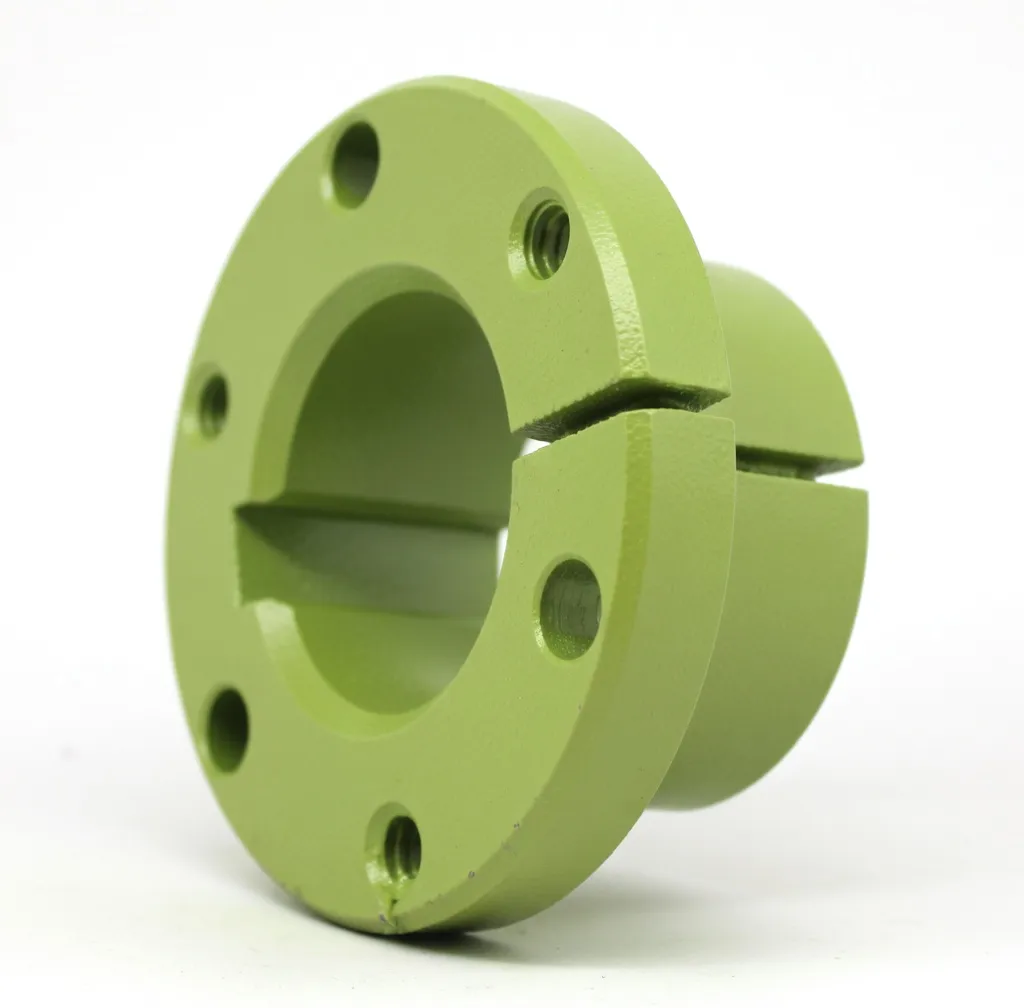 Walk into any major bulk cargo terminal along the Humber Estuary, the Thames Estuary, or the South Wales coast and you will find bucket wheel stacker-reclaimers moving iron ore, metallurgical coal, and imported grain with a quiet, almost hypnotic efficiency. What you will not see — buried inside the gearbox output flange connections, the pitch winch drum shafts, and the slewing mechanism sprocket hubs — are the QD bushings quietly doing one of the hardest jobs in port engineering.
A bucket wheel stacker-reclaimer is not a machine that forgives weak drive components. Its wheel diameter typically ranges between 5 and 10 metres. Its rotation speed is deliberately slow — commonly 5 to 15 RPM — yet the torque acting on the shaft connection can reach 150,000 to 500,000 Nm or beyond, depending on rated capacity. Add the intermittent shock loads that occur each time a filled bucket swings over the discharge chute, and you have a load spectrum that wears through conventional keyway-and-interference-fit connections within 12 to 24 months of continuous service.
QD bushings — specifically the large-bore, heavy-wall variants with marine-grade surface treatment — address this problem from the inside out. Their self-locking taper creates a radial clamping force distributed uniformly around the full shaft circumference, eliminating the stress-concentrating keyway notch that is almost always the starting point for fatigue failure in conventional connections. When combined with corrosion-resistant materials such as 316L stainless steel or Dacromet-coated high-tensile steel, QD bushings become the standard of choice for port engineers who have experienced the true cost of unplanned downtime at an active cargo terminal.

QD bushing assembly on a bucket wheel shaft at a UK coastal bulk terminal — bore 260 mm, 316L stainless steel body, Dacromet-treated A4-80 hardware
Understanding the Mechanical Challenge Inside a Bucket Wheel Machine
The drive system of a bucket wheel stacker-reclaimer is not a single shaft-and-hub pairing. It is a network of high-load connections distributed across at least three distinct mechanisms: the main bucket wheel drive, the pitch (luffing) winch, and the slewing drive. Each of these mechanisms presents a different torque profile and a different set of environmental hazards. Understanding these differences is essential when specifying the right QD bushing for each application point.
At the bucket wheel shaft itself, the dominant concern is sustained high torque with periodic shock loading. When a bucket bites into a compacted seam of iron ore or frozen coal, the instantaneous torque on the shaft connection can spike to 150% or more of the nominal rated torque within a fraction of a second. A conventional parallel-key connection responds to this spike by allowing the hub to micro-rock on the shaft — a movement of just 0.02 to 0.05 mm is enough to initiate fretting corrosion, which then accelerates fatigue crack growth at the keyway root. QD bushings eliminate this rocking mode entirely because the taper-lock geometry converts all radial forces into a distributed clamping contact around the shaft perimeter.
At the pitch winch drum, the challenge is quite different: bidirectional loading and significant bending moments caused by the cable wrap angle demand that the QD bushing resist both rotational torque and axial pull-out simultaneously. At the slewing mechanism, the concern is primarily low-speed, high-cycle fatigue — a machine may complete 50,000 or more slewing reversals per year, generating a demanding cumulative damage history for any fastened joint. Port environments along the UK coast amplify all of these problems by introducing chloride aerosols that attack any unprotected metal surface within months.
≤500,000 Nm
Peak Torque at Bucket Wheel Shaft
Handled by large-bore QD bushings with a 4° self-locking taper, providing a clamping force distributed across the full shaft circumference
5–15 RPM
Typical Bucket Wheel Rotation Speed
Ultra-slow speed combined with extreme torque demands maximum static friction coefficient — exactly what the taper-lock principle delivers
1,000+ h
Salt Spray Test Rating (ISO 9227)
Marine-grade QD bushings in 316L SS or Dacromet 500 treatment, independently verified — not simply stated on the catalogue sheet
Technical Performance Parameters
Heavy-duty QD bushing series for port stacker-reclaimer applications — standard and marine-grade variants. Custom bores available throughout the entire range.
| Series | Bore Range (mm) | Max Torque (Nm) | Taper Angle | Standard Material | Marine Option |
|---|---|---|---|---|---|
| QD-4040 | 75–115 | 62,000 | 4° | GGG50 Ductile Iron | Hot-dip Galv. / Dacromet |
| QD-4535 | 100–150 | 120,000 | 4° | C45 / GGG50 | 316L SS / Dacromet |
| QD-5040 | 115–180 | 195,000 | 4° | C45 Steel | 316L SS / Electroless Ni |
| QD-5050 | 130–220 | 280,000 | 4° | 42CrMo4 Steel | 316L SS / Dacromet |
| QD-6050 | 160–280 | 430,000 | 4° | 42CrMo4 Steel | 316L SS / Dacromet |
| QD-7060 (Custom) | 200–350+ | 700,000+ | 4° | 42CrMo4 / 34CrNiMo6 | Full 316L SS Body |
* Custom bore sizes to ±0.01 mm H7 tolerance available on all series. Torque ratings based on standard H7/p6 shaft fit with Grade 12.9 hardware at specified torque. Contact our engineering team with your machine data for verification.
The Engineering Principle: Why Taper-Lock Outperforms Conventional Fits at High Torque
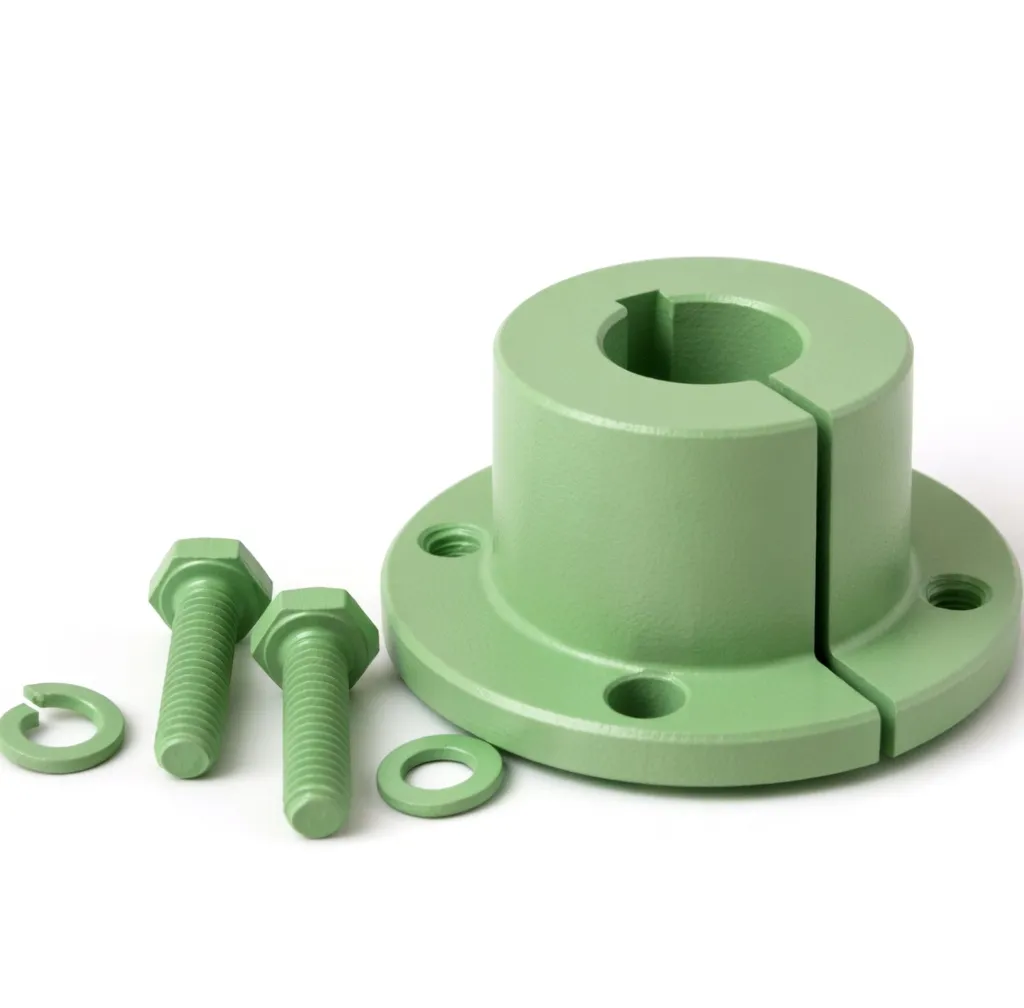 The operating principle of a QD bushing is elegantly straightforward, yet the engineering precision required to make it work reliably under 300,000 Nm loads is considerable. The bushing body is split along its length and machined to a precise 4° external taper. This taper seats into a matching 4° internal bore machined into the hub face of the mating component — typically a sprocket, a flanged coupling, or a chain wheel. The split-body design allows the bushing to compress slightly as it enters the taper bore, generating the radial clamping force that drives the connection.
When the mounting cap screws are tightened to the specified torque using a calibrated tool — or a hydraulic multiplier for the larger sizes used on port machinery — the axial force drives the bushing body deeper into the hub taper. This axial movement generates a radial compression force acting all the way around the shaft. The result is a friction-based drive connection with a clamping pressure distribution far more uniform than a parallel key can achieve. There are no stress-concentrating notches, no micro-clearances for salt moisture to exploit, and no asymmetric loading that would cause the shaft to run eccentrically under load.
Removal is equally well-engineered. The mounting screws are backed out and reinserted into the dedicated jacking holes machined into the bushing flange. As the screws engage the jacking thread, they push against the hub face and drive the bushing body out of the taper bore. The hub is free in minutes — without heat guns, bearing pullers, or the acetylene torch that is the last resort for a seized interference-fit assembly. Port maintenance teams across the United Kingdom have repeatedly reported reducing shaft-hub disassembly time from a full working day to under two hours using this jacking-screw removal method.
Material Selection for UK Coastal Port Environments
| Material | Tensile Strength (MPa) | Salt Spray Test (h) | Best For | Relative Cost |
|---|---|---|---|---|
| GGG50 Ductile Iron | 500 | 200 | Inland / sheltered sites | £ |
| C45 Steel + Hot-dip Galv. | 620 | 500 | Moderate coastal exposure | ££ |
| 42CrMo4 + Dacromet 500 | 900 | 1,000 | Active coastal ports, high torque | £££ |
| 42CrMo4 + Electroless Ni | 900 | 800 | Max-torque, moderate corrosion | £££ |
| 316L Stainless Steel | 515 | 1,500+ | Tidal zone, North Sea coast | ££££ |
Three Critical Application Points on Every Bucket Wheel Machine
QD bushings are not a single-point solution on a bucket wheel stacker-reclaimer. Correctly specified and installed, they appear at multiple drive interfaces across the entire machine — each with its own torque profile, failure mode, and corrosion exposure level.
1
Bucket Wheel Shaft to Gearbox Output Flange
This is the highest-torque connection point on the machine and the most demanding in terms of QD bushing specification. The torque transmitted here includes not only the continuous cutting torque but also the peak shock loads from material impacts. QD bushings at this position are typically QD-5050 or QD-6050 series units, machined to a custom bore matching the gearbox output shaft to H7 tolerance. Keyway-assisted variants are available for machines with rated capacities exceeding 4,000 tonnes per hour, where the design specifies both a taper-lock and a parallel key as a dual safety measure. The connection must also maintain true concentricity between the gearbox shaft and the bucket wheel shaft centreline — any misalignment will generate cyclic bending loads that degrade both bearing life and bushing clamping pressure over time. At an active UK coastal port, marine-grade surface treatment is essential at this location: even a small amount of crevice corrosion between the taper surfaces will reduce the effective clamping coefficient, allowing the hub to slip under shock load at a fraction of the rated torque.
2
Pitch Winch (Luffing Winch) Drum Shaft
The pitch winch raises and lowers the entire boom assembly of the bucket wheel machine, changing the reclaiming height. On a large stacker-reclaimer, the boom assembly can weigh 200 to 500 tonnes, which means the pitch winch drum experiences extremely high cable tensions and substantial bending moments acting on its shaft. QD bushings used here are typically mid-range in size — QD-4535 or QD-5040 — but must be specified with bolt tensioning verified by a hydraulic torque wrench to ensure uniform clamping across all fixing positions. Manual torque wrenches cannot reliably achieve the bolt torques involved, which often fall in the range of 800 to 2,000 Nm per screw. Salt spray corrosion is particularly critical at this location because the winch drum is mounted on the upper boom structure, directly exposed to coastal winds carrying seawater aerosols from tidal flats. Several UK port maintenance teams have reported that this was the first location where standard ductile iron QD bushings began to show surface corrosion, simply because of its elevated, exposed position on the boom.
3
Slewing Mechanism Chain Sprocket Drive
The slewing mechanism rotates the entire boom assembly around the machine’s central slew bearing, allowing the bucket wheel to traverse the full width of the stockpile. The chain sprocket drives involved in this mechanism are subject to bidirectional loading and a very high accumulated cycle count — a machine may complete 50,000 or more slewing reversals per year. QD bushings here are typically QD-4040 or QD-4535 series, but the corrosion protection specification is no less critical than at the bucket wheel shaft. A sprocket that seizes onto its shaft due to salt-induced corrosion has caused more than one unplanned multi-day shutdown at UK port terminals when the sprocket needed emergency replacement after premature wear. Marine-grade Dacromet or 316L stainless QD bushings at this location have consistently extended the maintenance interval from approximately 8 months to over 36 months in documented reports from UK bulk terminal operators. The bidirectional loading also means that any fretting corrosion developing on the shaft contact surface gets loaded from both directions on every slewing cycle — making early-stage degradation accelerate far faster here than at a unidirectional drive.
Six Reasons Port Engineers Across the UK Specify QD Bushings
These are not marketing generalisations. They are engineering realities observed during commissioning, inspections, and maintenance shutdowns at active UK port bulk terminals.
⚡ Keyless Connection — No Fatigue-Initiating Stress Risers
Traditional parallel-key connections introduce a notch at the keyway root where fatigue cracks routinely initiate under cyclic loading. QD bushings transmit torque through distributed friction contact over the full taper surface area — typically 3 to 6 times larger in effective contact area than a keyway land. This eliminates the fatigue initiation site entirely. On a machine operating 7,500 hours per year under continuous cyclic loading, this difference alone can extend shaft service life by a factor of three to five.
🔍 Inherent Self-Centring to ±0.02 mm TIR
The 4° taper geometry centres the hub relative to the shaft automatically during the mounting sequence. This achieves running concentricity values of 0.01 to 0.03 mm TIR (Total Indicator Reading) without the need for additional alignment fixtures — a significant benefit on a machine where the connected components weigh several tonnes and precise alignment is otherwise difficult to achieve in a port maintenance environment with limited crane access.
🕐 60–70% Faster Maintenance Turnaround
Port terminals operate under cargo handling timetables that typically allow maintenance windows of 8 to 24 hours between vessel arrivals. QD bushing installation requires only torque-controlled tightening of the mounting cap screws in a defined cross-tightening sequence — achievable by two technicians in 45 to 90 minutes for a large-bore bushing. This compares with the 4 to 8 hours needed to heat-shrink, cool, and pull a conventional interference-fit hub, and delivers enormous value in a time-critical terminal environment where every hour of downtime has a direct cost attached to it.
🏗 Custom Bore for Any Non-Standard Shaft Diameter
Older bucket wheel reclaimers installed in UK ports during the 1980s and early 1990s frequently have shaft diameters that do not correspond to any current catalogue bushing size. Custom-bore QD bushings, finish-machined to any dimension between 25 mm and 350 mm at ±0.01 mm H7 tolerance, allow direct replacement without needing to remachine the shaft — a major cost saving when the shaft is a safety-critical, long-lead-time component. Our workshop accepts dimensioned drawings, sketches, and worn samples as the basis for custom manufacture.
🏥 Genuinely Marine-Grade Corrosion Protection
Standard off-the-shelf QD bushings are not designed for continuous salt spray exposure. Our port-optimised variants carry either Dacromet 500 coating (1,000 h salt spray per ISO 9227), full electroless nickel plating (800 h), or solid 316L stainless steel construction (1,500 h+). All mounting hardware on marine-grade orders is supplied in A4-80 stainless steel as standard. This reflects what UK port terminal engineers have actually told us they need, not what meets the minimum catalogue specification.
📄 Full Compliance Documentation as Standard
Every QD bushing supplied for a port machinery application is backed by a full EN 10204 3.1 material traceability certificate, CMM dimensional inspection report, and surface treatment test certificate. These documents are not optional extras — they form part of the standard delivery package for any safety-critical mechanical installation, as required under UK health and safety regulations and typical port operator procurement specifications. Our paperwork is accepted by major UK terminal operators and their insurers without amendment requests.
Customer Success Story
Bulk Terminal Operator · Port of Immingham, Lincolnshire, UK · Iron Ore & Coal Handling · Installed 2021 · 30-Month Performance Review
📌 The Situation
A bulk materials handling operator at the Port of Immingham — the United Kingdom’s largest port by total annual tonnage — was experiencing rapidly accelerating wear and recurrent failure at the gearbox output flange connection of a Thyssenkrupp-designed bucket wheel stacker-reclaimer rated at 3,500 tonnes per hour. The machine operated three shifts per day handling iron ore fines and metallurgical coal, and the combination of high continuous torque, intermittent shock loading from compacted ore seams, and pervasive tidal salt aerosol had destroyed two conventional interference-fit hub connections in under 18 months. Direct replacement and downtime costs exceeded £120,000 per incident when the full impact on vessel berthing schedules was accounted for.
⚙ The Solution
After consulting with our application engineering team and sharing the original gearbox drawings plus a dimensional report on the as-worn shaft, the operator specified a custom QD-6050 bushing machined to a bore of 268 mm to match the worn shaft diameter, manufactured in 42CrMo4 high-alloy steel with a full Dacromet 500 surface treatment on the bushing body and A4-80 stainless steel cap screws throughout. Installation was carried out during a 16-hour planned maintenance window using a hydraulic torque multiplier to achieve the specified 1,650 Nm bolt torque consistently across all eight mounting positions. A secondary pair of QD-4535 units in solid 316L stainless steel were also installed on the slewing mechanism sprocket shafts during the same shutdown, taking advantage of the crane access that was already in place.
🏆 The Outcome — 30 Months Later
At the 30-month inspection carried out during the scheduled annual overhaul, both the primary QD-6050 bushing and the slewing mechanism QD-4535 units showed no measurable corrosion on the taper contact surfaces, no micro-movement evidence, and no loss of bolt pre-load beyond the expected 8% thermal settling. The terminal’s maintenance superintendent confirmed that the connection had performed without any intervention for the entire 30-month period — a striking contrast to the 6–8 month failure cycle of the previous connection design. The capital investment in the QD bushing assembly paid back within the first prevented failure event, with cumulative savings in downtime costs exceeding £240,000 across the review period.
30 months
Zero connection failures
£240,000+
Downtime cost avoided
16 hrs
Installation window
4× longer
Maintenance interval
What Port Engineers Are Saying
Feedback from maintenance teams and OEM engineers specifying our QD bushings for port and bulk handling applications
“We had tried two other suppliers before switching over. The difference was not just in the corrosion resistance — the dimensional accuracy was genuinely better. Every bushing came with a 3.1 certificate and the bore was right on the money. For a machine turning at 8 RPM under 280,000 Nm, there is no room for guesswork in the tolerances.”
— James T., Senior Mechanical Engineer
Bulk Terminal Operations, Humber Estuary, UK
“As a port equipment OEM, we integrate QD bushings into our chain-driven slewing systems as standard on new builds. The availability of custom bore sizes machined to our exact drawing specifications, combined with the Dacromet option, means we can guarantee our customers a corrosion-maintenance-free slewing drive for a minimum of three years — which is a strong commercial argument for terminals operating along the North Sea and Irish Sea coastlines.”
— Pieter V., Drive Systems Design Engineer
Port Machinery OEM, Antwerp, Belgium
“Our stacker-reclaimer at the coal import terminal handles around 1.2 million tonnes a year in one of the saltiest environments you’ll find in Scotland. We replaced the original gearbox output connection with a QD-5050 in 316L stainless and have not touched it in two years. The lads on the maintenance team appreciate how quickly it comes off if it ever needs attention — no more cutting out seized hubs.”
— Alasdair M., Operations Manager
Coal Import Terminal, Forth Estuary, Scotland, UK
Custom QD Bushing Manufacturing: Built Precisely to Your Machine’s Specification
Not every bucket wheel stacker-reclaimer at a UK port terminal was built to current catalogue standards for shaft diameters, hub bore depths, or taper angles. Machines installed during the 1980s and 1990s may have been designed to DIN, AFNOR, or entirely bespoke in-house standards. Attempting to fit a standard-catalogue QD bushing into a non-standard hub taper is one of the most common causes of premature taper surface galling — and it has cost more than one operator a new hub casting at considerable expense. The solution is custom manufacture, and this is where our workshop capability genuinely sets us apart.
Our CNC turning centres handle bores from 25 mm to 350 mm and outer diameters up to 800 mm. Every custom QD bushing is machined from certified material stock, with dimensional verification by CMM against the customer’s approved drawing, and a full inspection report supplied with each unit. We regularly produce reverse-engineered drawings from worn samples sent by port maintenance teams — a service that has proved invaluable when the original machine documentation has been lost, superseded, or never translated into English. Single-piece orders are accepted for emergency breakdown situations, with expedited lead times as short as 3 to 4 working days.
🆕 Our Customisation Capabilities at a Glance
Bore range 25–350 mm at ±0.01 mm H7 tolerance • Outer diameter up to 800 mm • Taper angles 4°, 5°, 6° or customer-specified • Materials GGG50 / C45 / 42CrMo4 / 34CrNiMo6 / 316L SS • Treatments: Dacromet 500, hot-dip galvanising, electroless nickel, PVD TiN • Hardware Grade 12.9 or A4-80 SS • Batch size 1 piece to 10,000+ • Lead time 7 days standard, 4 weeks custom certified • EN 10204 3.1 certificates and CMM reports standard • Reverse engineering from worn sample accepted
Ready to solve your bucket wheel drive connection problem?
Send us your shaft diameter, hub bore drawing or sample, operating torque and environmental details. Our engineering team will respond with a specification recommendation and quotation within 24 hours.
QD Bushings for UK Port Terminals: Why Coastal Location Shapes the Specification
The United Kingdom’s bulk cargo infrastructure is concentrated at a handful of deep-water terminals, primarily along the Humber Estuary (Immingham, Grimsby, Hull), the Thames Estuary and Kent coast (Tilbury, Sheerness), the Bristol Channel (Port Talbot, Newport, Barry), and Scotland’s East Coast (Grangemouth, Leith, Methil). Each of these locations carries a BS EN ISO 9223 atmospheric corrosivity classification of at least C3 — meaning standard ductile iron QD bushings without protective treatment will begin showing significant corrosion within 12 months of outdoor installation. Many of these locations fall into C4 or C5 classification during winter months when tidal spray is driven inland by prevailing westerly gales.
The North Sea and Irish Sea coastlines generate chloride aerosol concentrations that penetrate into mechanical assemblies far more aggressively than inland industrial environments. In our experience working with UK terminal operators, chloride contamination is regularly found in shaft-hub interfaces that are not visibly exposed to spray — it enters through the clearance gaps in the hub joint, condensates on cold metal surfaces during overnight temperature drops, and remains trapped in contact with the metal long after the original spray event. This explains why standard galvanised finishes underperform at coastal terminals: the zinc layer is consumed within 18 to 24 months, leaving bare metal exposed to a continuously replenished chloride environment.
We supply QD bushings to maintenance teams and OEM procurement departments across England, Scotland, and Wales. Established delivery routes cover Lincolnshire, South Yorkshire, East Riding, Essex, Kent, South Wales, and the Scottish central belt. Same-day despatch is available on standard-catalogue items for orders placed before noon GMT. Custom certified orders are airfreighted or sent by tracked priority courier to minimise lead time for time-critical replacement situations. Port terminal maintenance planners, plant engineers, and procurement managers are welcome to contact our UK accounts team directly for a technical discussion — there is no minimum order value for custom enquiries.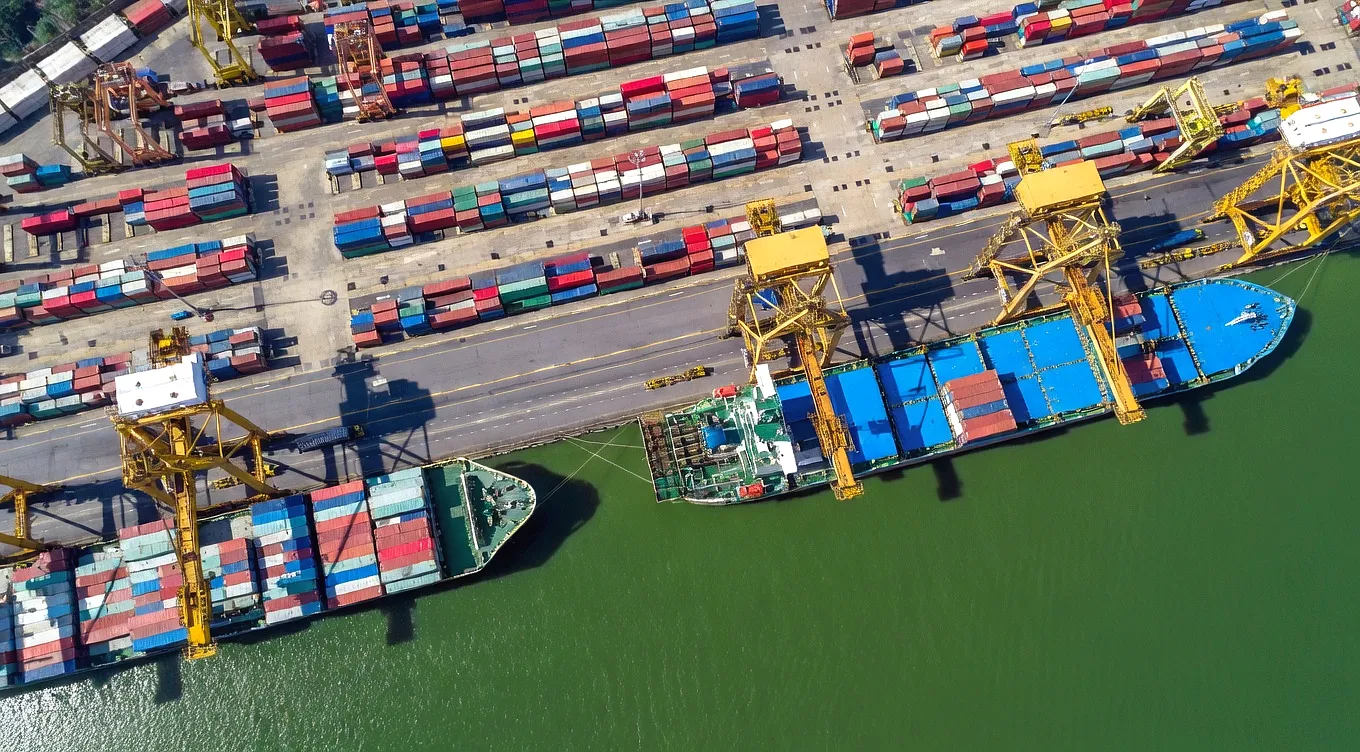
Frequently Asked Questions
Technical and commercial questions from port terminal engineers and procurement teams across the UK, answered by our application engineering team
QD Bushings for Bucket Wheel Stacker-Reclaimers — Heavy Industry Drive Solutions for UK Port Bulk Cargo Terminals
© QD-Bushings.top • ISO 9001 Certified • Custom Specifications Welcome • [email protected]
edit by gzl