
Mining Industry · Conveyor Drive Systems · UK Heavy Industry
QD Bushings for Mining Conveyor Belt Drive Systems: Engineering Reliability When Failure Is Not an Option
Thousands of tonnes of ore move every single day across UK mining operations. The shaft-to-hub connection holding those drive systems together is often the last component that gets proper attention — until it fails.
 After eighteen years of specifying and troubleshooting power transmission components across heavy extraction industries, I can point to one pattern that repeats itself with uncomfortable regularity: maintenance budgets go to gearboxes, motors and bearings — while the bushing connecting the drive pulley to the head shaft gets selected from a catalogue in five minutes, often by the most junior engineer in the room. That approach works fine, right up until a QD bushing seizure brings a 2,000-tonne-per-day limestone quarry to a complete standstill on a Friday afternoon. I have attended those calls. They are expensive, avoidable, and almost always traced back to an incorrect specification or an unsuitable material grade for the actual operating environment.
QD bushings — Quick Detachable taper-lock bushings — occupy a genuinely critical position in the mining conveyor drive train. They form the precision mechanical interface between the drive pulley hub and the head shaft, transmitting the full rated torque of a gearbox-motor assembly that may be delivering anywhere from 37 kW on a short in-pit feeder belt to 1,500 kW or beyond on a main overland haulage conveyor. Belt widths in UK mining and quarrying range from 600 mm on narrow underground roadway belts up to 2,400 mm on major surface operations, and the QD bushing at the drive end of each one must perform faultlessly across that entire spectrum of size, load, environmental exposure and maintenance accessibility.
This article covers the engineering principles behind QD bushing performance in mining conveyor applications, the material science that separates a component with a seven-year service life from one that fails in eighteen months, the specific UK regional environments — from Welsh coal washeries to Scottish potash mines — that dictate corrosion protection choices, and the real-world performance data that procurement engineers across England, Scotland and Wales are using to build a business case for specifying heavy-duty mining-grade QD bushings rather than catalogue standard units.
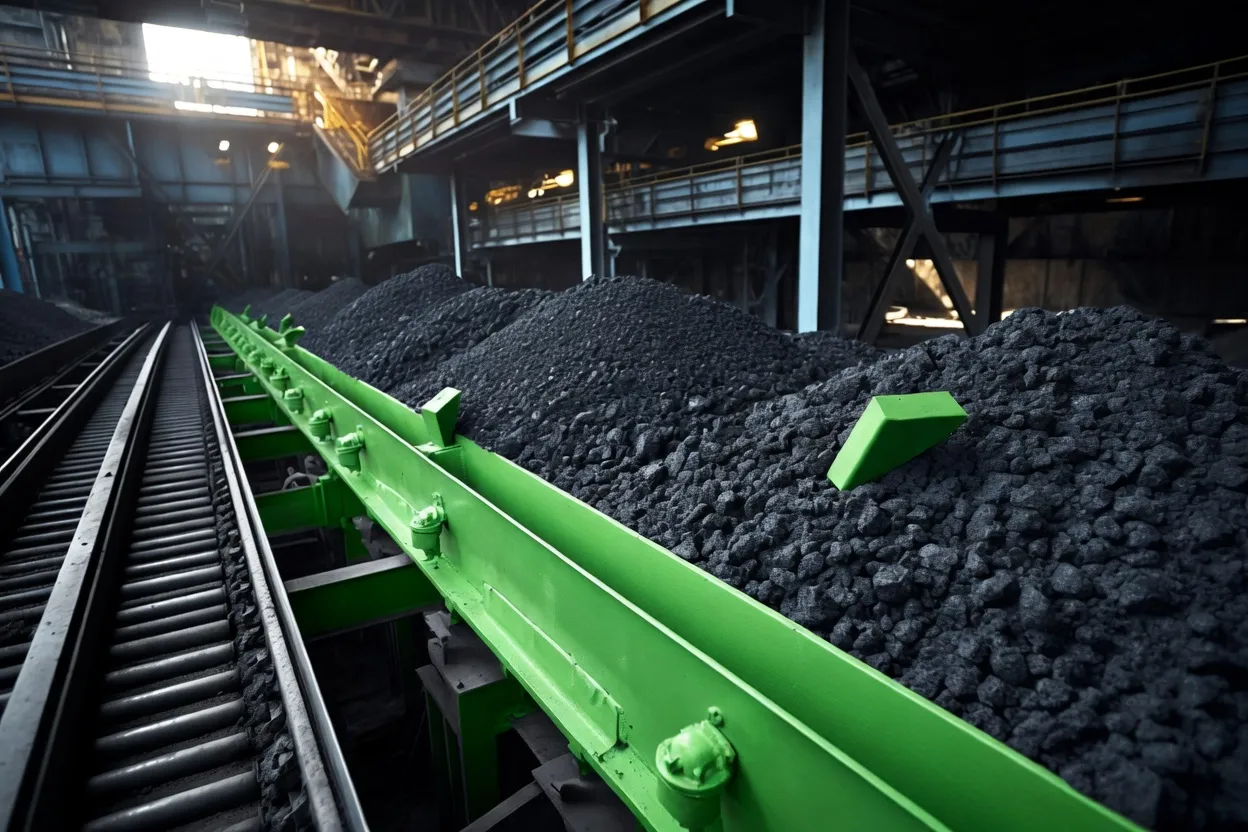
Heavy-duty QD Bushings on a mining conveyor belt drive pulley — built for continuous high-load operation in UK quarrying and mining environments
The Engineering Principle: What Makes a QD Bushing Different in a Mining Drive System
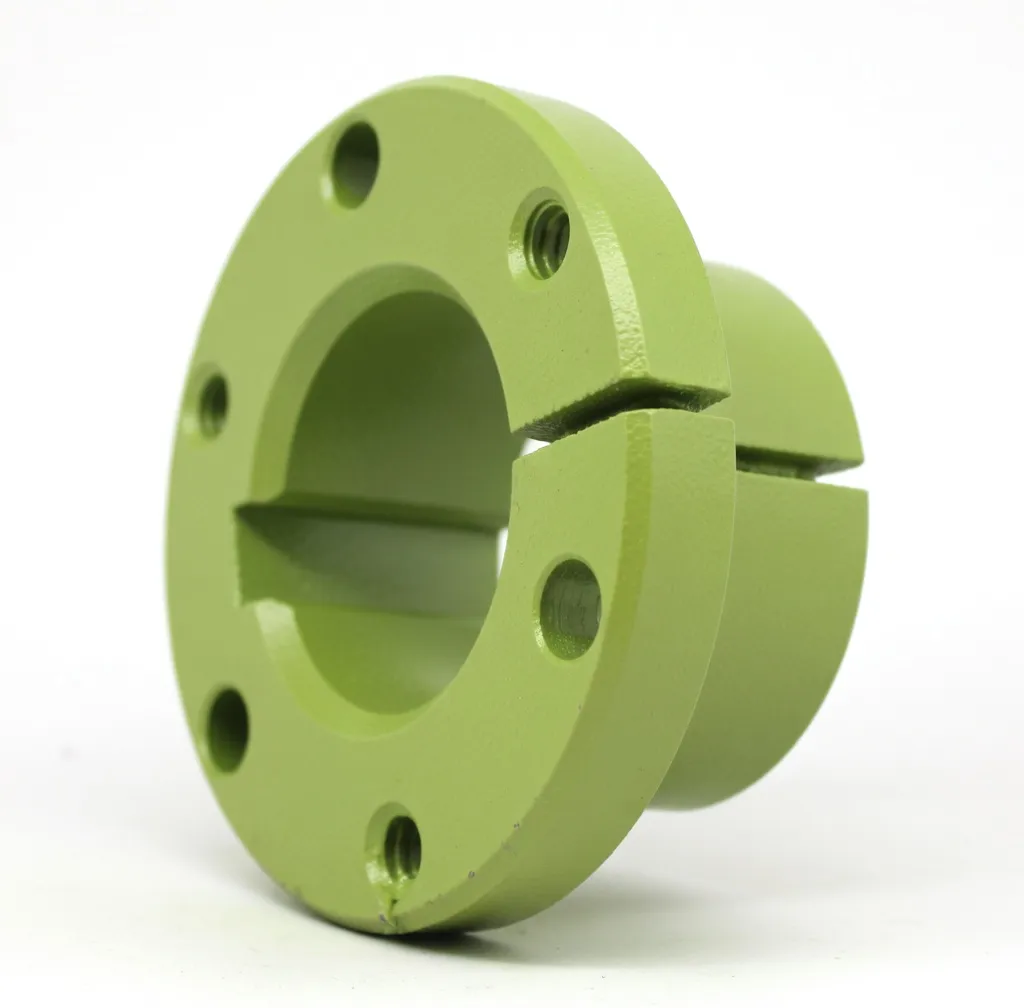
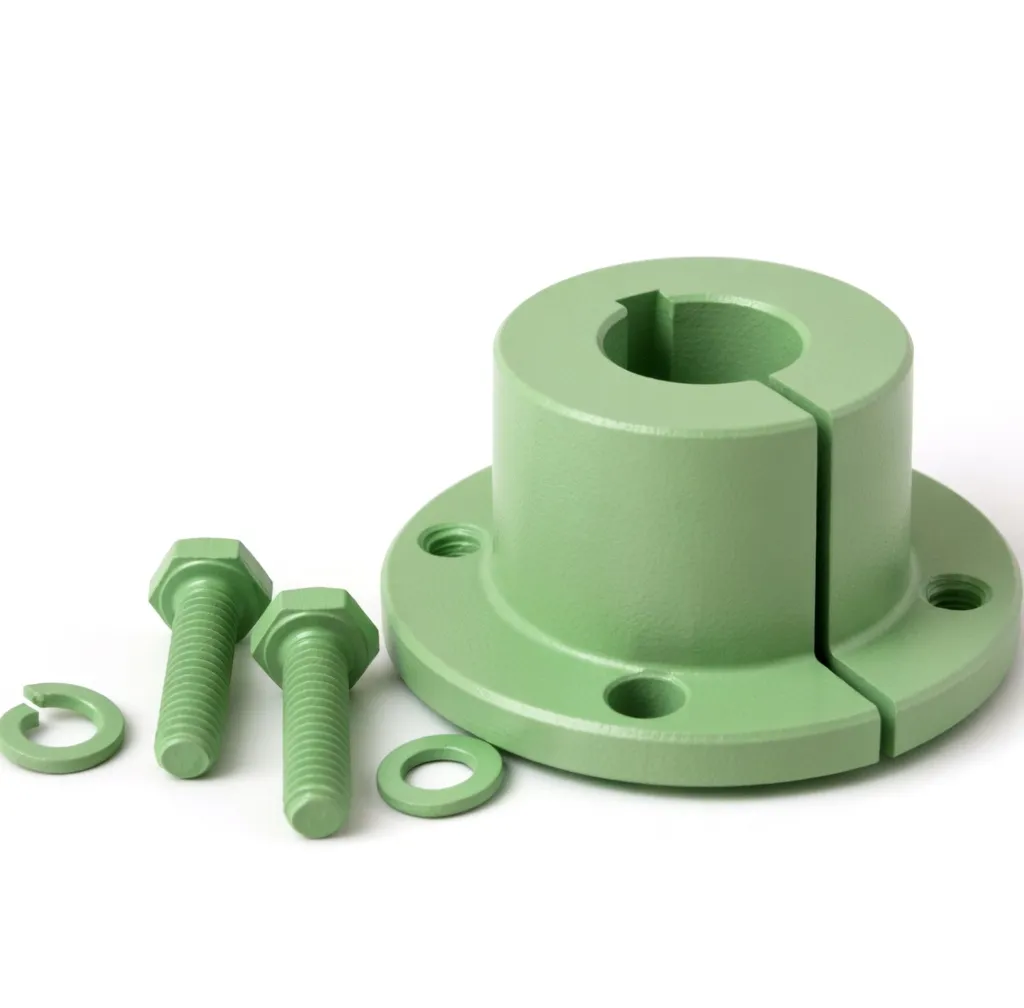 A QD bushing is a split-taper, self-locking hub component designed to mount pulleys, sprockets, sheaves and coupling hubs onto drive shafts. The taper geometry — typically a 4° included angle on standard units — generates a powerful radial clamping force when the mounting flange bolts draw the bushing body into the matching tapered bore of the hub. The clamping mechanism is entirely mechanical, requires no adhesive, no heating, and no hydraulic press. Critically, each QD bushing also carries purpose-drilled jacking threads in the flange — the same threaded holes used for installation are used for removal, with the bolts relocated to push the bushing clear of the hub taper. This single design detail is what transforms routine pulley maintenance from a multi-hour heat-and-press operation into something a fitter with a socket set and a torque wrench can complete before the end of a maintenance shift.
In a mining conveyor drive system, this matters enormously. The drive pulley — the component that physically moves the belt — must transmit the full motor torque to the belt through the friction interface between the pulley lagging and the belt’s rubber cover. The QD bushing is the mechanical joint that connects this pulley to the head shaft, which in turn receives its power from the gearbox output flange. Any micro-slip, fretting wear, or progressive loosening at the bushing interface corrupts the entire torque delivery chain and leads to progressive shaft damage that ultimately forces a complete drive assembly replacement — an event that, on a 1,200 mm belt conveyor, typically costs between £15,000 and £40,000 including parts, crane hire and lost production.
The zero-backlash characteristic of the QD bushing taper design is particularly valuable in mining applications because conveyor drives are subjected to substantial cyclic loading variation. A fully loaded 800 mm belt carrying 500 tonnes per hour imposes a dramatically different drive torque than the same belt running empty during a cleaning cycle. Each load transition generates a torque reversal at the bushing interface. Over thousands of cycles per day, these reversals are precisely the loading conditions that destroy keyway flanks through fretting corrosion in conventional keyed hub arrangements. The QD bushing’s distributed taper contact eliminates the stress concentrations at keyway corners and spreads the cyclic load across a far larger contact area — a difference that translates directly into extended component life under mining operating profiles.
Technical Performance Parameters: QD Bushings for Mining Conveyor Drive Applications
The parameters below represent typical performance characteristics for industrial and heavy-duty mining-grade QD bushings. Standard-grade units follow ISO 5291 and ANSI/ASME B29.26 dimensional standards. Actual selection requires confirmation of shaft diameter, keyway configuration, transmitted torque including service factor, and the specific environmental conditions of your installation. Our technical team provides free specification review for all UK mining and quarrying enquiries.
| Parameter | Standard Industrial | Heavy-Duty Mining Grade | Unit |
|---|---|---|---|
| Bore Diameter Range | 12 – 115 | 25 – 190 | mm |
| Max. Transmissible Torque | Up to 8,500 | Up to 28,000 | Nm |
| Taper Angle (Included) | 4° | 4° – 7° (application-specific) | degrees |
| Body Material — Standard | Cast Iron GG25 | Ductile Iron / Carbon Steel | — |
| Bore Tolerance | H8 | H7 (precision ground) | — |
| Surface Treatment | Phosphate / Electro-zinc | Hot-dip galvanised / Two-part epoxy | — |
| Operating Temperature | -20 to +100 | -30 to +150 | °C |
| Belt Width Compatibility | 600 – 1,200 | 900 – 2,400 | mm |
| Drive Power Range | 11 – 250 | 90 – 3,000 | kW |
| Keyway Standard | BS 4235 / DIN 6885 | BS 4235 / Custom double-key | — |
| IP Protection (sealed variants) | IP54 | IP65 / IP67 | — |
| Expected Service Life (mining) | 18 – 30 months | 4.5 – 7 years | — |
Six Reasons UK Mining Engineers Specify Heavy-Duty QD Bushings
Rapid Removal — Under 30 Minutes
The jacking thread system means removal requires only a standard socket set and the same bolts used during installation. No hydraulic pullers, no oxy-acetylene torches, no shaft damage. A UK mine running two planned maintenance shifts per week can recover over 90 hours of productive uptime annually versus interference-fit alternatives — a figure that typically exceeds the total cost of the bushing set within the first twelve months.
Zero-Backlash Torque Transmission
Once torqued to specification, the self-locking taper ensures absolutely no relative movement between shaft and hub. In a mining conveyor experiencing cyclic load transitions — start-stop sequences, belt sag, loaded versus empty conditions — this eliminates the fretting corrosion and progressive keyway wear that destroys conventional keyed hubs over 18–24 months of heavy-duty service. The distributed taper contact area means the cyclic load is spread rather than concentrated at keyway corners.
Built for UK Mining Environments
Heavy-duty mining-grade QD bushings carry hot-dip galvanised or two-part epoxy coatings that withstand the acidic condensation common in South Wales coal washeries and the saline groundwater seeping into North Yorkshire potash operations. Ductile iron or carbon steel body construction maintains structural integrity under the dynamic impact loads generated by freshly crushed granite or raw limestone falling onto the receiving belt — loads that would crack standard grey cast iron units.
Standardised and Interchangeable
QD bushings follow standardised series designations — JA, SH, SK, SF, E, F, J, M, N, P, W, S — that are dimensionally consistent across manufacturers. A UK procurement manager can maintain a small buffer stock covering multiple conveyor sizes rather than holding proprietary components with 8–12 week overseas lead times. This standardisation also simplifies MRO catalogue management on multi-site quarrying operations where three or four different conveyor sizes coexist.
Shaft Protection and Reusability
The taper clamping mechanism transfers its load through the bushing body rather than pressing directly against the shaft OD. The shaft surface remains unmarked during removal. A head shaft on a 1,200 mm belt conveyor can cost £3,000–£8,000 to replace; QD bushings extend shaft life by eliminating the scoring, galling and stress risers that press-fit hubs cause over repeated assembly cycles. The bushing itself can also be reused multiple times if maintained correctly — an additional cost advantage over single-use interference hubs.
Superior Whole-Life Cost
When UK mining operations calculate total cost of ownership — initial component price, installation and removal labour, shaft repair costs, and lost production during unplanned stoppages — heavy-duty QD bushings consistently outperform alternatives. Industry data from UK surface mining sites indicates mean time between bushing-related failures of 4.5 to 7 years on correctly specified units, versus 18–24 months for equivalent interference-fit setups under identical cyclic loading conditions.
Material Science and Construction: Why Grade Matters More Than Brand in Mining
Standard commercial-grade QD bushings are machined from GG25 grey cast iron — adequate for light-to-medium industrial duty but a poor choice for the loading profile found in mining conveyor drives. Grey iron is a brittle material with tensile strength around 220–250 MPa and negligible ductility. Under the repeated impact loads generated by large lump ore hitting the belt — a crusher discharge belt handling 400 mm topsize granite produces transient shock loads on the drive pulley that can briefly exceed eight times the steady-state torque — grey iron’s propensity to initiate and propagate cracks under dynamic loading makes it a failure risk rather than a reliability asset.
Heavy-duty QD bushings for mining conveyor applications are specified in ASTM A536 Grade 65-45-12 ductile iron. The spheroidal graphite microstructure that distinguishes ductile iron from grey iron provides elongation values of 12% minimum — the component deforms plastically before fracturing, absorbing impact energy rather than cracking under it. Tensile strength of 448 MPa combined with 310 MPa yield strength means a ductile iron QD bushing can withstand peak starting torques at 2.0–2.5 times rated running torque without permanent deformation. For the highest-demand applications — such as the drive end of a 2,200 mm wide overland surface belt at a Scottish opencast site — forged carbon steel in SAE 1045 or BS 970 080M46 provides the ultimate combination of toughness, fatigue endurance limit, and keyway machinability.
Precision machining is the second material consideration that separates mining-grade QD bushings from budget catalogue units. Every bore is ground to H7 tolerance — a fit standard ensuring the mating shaft enters without interference during installation while the tapered outer surface generates correct clamping pressure when bolts are torqued to specification. Bore concentricity matters equally: a QD bushing bore that is 0.05 mm eccentric on a 500 mm drive pulley generates measurable vibration at operating belt speeds, accelerating bearing wear and reducing structural fatigue life across the entire drive assembly. Poorly machined budget units that appear dimensionally similar frequently fail this concentricity criterion by a significant margin.
Corrosion protection for UK mining environments deserves rigorous specification. Operations in South Yorkshire coal washeries, Pennine aggregate quarries, and Welsh underground mines expose drive components to persistent moisture, acidic mineral fines, wash-down water and proprietary cleaning additives. Hot-dip galvanising to BS EN ISO 1461 provides 85–100 micron zinc coating thickness — outlasting electrolytic zinc plating by a factor of three to four in wet underground conditions. Where galvanising is impractical for precision bore sections, a two-part epoxy primer followed by polyurethane topcoat on all external surfaces provides equivalent corrosion life without dimensional build-up on functional surfaces. For potash brine environments in the Woodsmith Project area of North Yorkshire, 316L stainless steel body material eliminates the corrosion risk entirely at the cost of a higher initial unit price.
QD Bushing Application Points Across the Mining Conveyor System
A modern mining conveyor cascade is not a single application — it is a sequence of drive points with distinct loading profiles, environmental exposures, and maintenance access constraints. The correct QD bushing specification differs meaningfully between these positions.
► Head/Drive Pulley Connection
The highest-torque point in any belt conveyor system. The QD bushing at the head pulley connects the hub to the shaft receiving power from the main gearbox. On a 1,500 kW surface mine drive, this connection must sustain peak starting torques 2.0–2.5 times the rated running value. Specifying a bushing with a 150% safety factor over calculated peak torque, using a service factor appropriate to heavy shock loading (typically 1.75–2.0 per BS ISO 6336 guidance used by UK mechanical engineers), is standard practice here.
► Crusher Discharge Belts
The conveyor immediately downstream of a primary jaw or gyratory crusher carries the most abrasive, highest-impact material in the process — freshly crushed rock with sharp angular faces and unpredictable lump size variation. Impact loads transferred through the belt to the drive pulley and into the QD bushing are extreme and highly irregular. Ductile iron construction, increased flange bolt torque, and a service factor of 2.0 or higher are mandatory specifications in this position for any UK quarry processing hard rock.
► Incline and Decline Haulage Belts
Underground mine haulage belts operate on gradients up to 18° carrying ore continuously from face to shaft bottom. The axial component of belt tension under full load creates a secondary force on the QD bushing’s taper interface — a vector that standard catalogue specifications often fail to account for. Careful bushing series selection to manage the combined torque and axial force, along with specifying a double keyway configuration to share keyway load, is essential on steep-gradient UK underground applications.
► Chute Loading and Transfer Belts
Transfer chutes generate sudden, high-magnitude torque spikes on the receiving belt’s drive pulley as material impacts from above. These brief but intense dynamic loads — which can reach three to four times the steady-state torque value over periods of milliseconds — are precisely the failure mechanism that ductile iron QD bushings are designed to survive. A service factor of 1.75 or above on the nominal torque calculation is the recommended starting point at every transfer point in a multi-conveyor UK processing circuit.
► Stockpile Stacker Conveyors
Stacker conveyors at UK aggregate and coal operations extend 60 metres or more and rotate through 360°. The radial pivot arrangement introduces additional bending moments at the drive pulley shaft, requiring QD bushings with enhanced concentricity tolerances and, in certain configurations, moment-load rated variants that distribute the combined torque and bending load across a wider taper contact zone. This is a frequently under-specified application that we encounter regularly when reviewing drive train failures on UK quarry stacking systems.
Case Study: Eliminating Repeat Conveyor Failures at a Scottish Granite Quarry
Client
Highland Aggregates Ltd*
Location
Highlands, Scotland
Sector
Granite Aggregate Mining
Drive System
1,200 mm belt · 375 kW · 22° incline
*Name changed. Application details accurate.
The Problem
Highland Aggregates was experiencing three unplanned conveyor stoppages per month on their primary crusher discharge belt — a 22° inclined conveyor handling up to 800 tonnes per hour of freshly crushed granite with a maximum lump size of 250 mm. Each stoppage required 4–6 hours to diagnose, source parts and recommission, costing the operation between £12,000 and £22,000 per incident in lost production and emergency labour. The failure pattern was consistent: conventional keyed hub connections between the drive pulley and the 120 mm head shaft were developing progressive fretting wear under the cyclic impact loading of the granite feed. By the time the wear became apparent through vibration monitoring alerts, the shaft surface was already irreparably scored and required a complete drive assembly swap.
The Solution
Working with our technical team, Highland Aggregates’ maintenance engineer specified a pair of heavy-duty QD bushings — Series N, 130 mm bore, ductile iron body, hot-dip galvanised, double keyway to BS 4235 — to replace the original press-fit keyed hubs. Installation was completed in a single planned maintenance shift. The taper clamping mechanism distributes the drive torque far more evenly across the contact zone, eliminating the stress concentration at the keyway flanks that had been the root cause of the fretting failure mode. Flange bolt torque was set at 115% of standard catalogue value, in line with the shock loading service factor of 1.9 calculated for the crusher discharge application.
Results — 18 Months Post-Installation
0
Bushing-related stoppages in 18 months
£54k+
Avoided emergency repair costs
23 min
Most recent planned inspection time
7.2%
Improvement in conveyor OEE
What UK Mining and Quarrying Engineers Say
★★★★★
“We’ve run four crusher discharge belts on these QD bushings for over two years without a single unplanned stoppage related to the drive connection. The installation took our fitter less than an hour per pulley. We have standardised on this product across all our North Yorkshire quarry sites and the procurement team appreciates having one consistent specification across the group.”
— James H., Maintenance Engineering Manager
Limestone Quarry Operations, North Yorkshire, England
★★★★★
“The technical team walked us through the correct QD bushing series for our underground haulage belts. The hot-dip galvanised units have handled the wet, acidic conditions in our South Wales pit without any sign of corrosion damage after 30 months of continuous service. Lead time was five days from order — that matters when you are trying to keep a colliery moving and need confidence in supply.”
— Rhodri T., Electrical and Mechanical Supervisor
Underground Coal Operation, Rhondda Cynon Taf, Wales
★★★★★
“We needed a non-standard bore — 97 mm with a double keyway and a specific flange bolt circle to match our existing pulley hubs. The engineering team came back with a custom-machined solution within seven days and the dimensions were spot on. We have since ordered a batch covering our entire Scottish potash conveyor system. The machining finish is clearly precision work, not mass-produced commodity parts.”
— Alasdair M., Procurement Director
Potash Mining Operations, Caithness, Scotland
Serving Mining and Quarrying Operations Across England, Scotland and Wales
The UK mining and quarrying sector encompasses genuinely diverse operations — the hard rock granite quarries of Cornwall, Devon and Aberdeenshire; the potash deposits beneath the North York Moors and Caithness; the deep coal heritage workings of South Wales and County Durham; the sandstone and limestone aggregate operations throughout the Pennines and Peak District; gypsum mines in Nottinghamshire; and silica sand operations in Cheshire and Staffordshire. Each geology, each extraction method, and each processing flow imposes a different combination of loading, environmental exposure and maintenance accessibility on conveyor drive components. A QD bushing specified for a dry Pennine limestone quarry processing 600 mm lump stone is a different engineering proposition from one running continuously in an underground South Wales coal roadway 400 metres below surface in the presence of methane and saline water.
For procurement engineers responsible for MRO supply to UK quarrying and mining sites, having a supplier with both the technical depth to get the specification right and the logistics capability to deliver quickly is not a luxury — it is a continuity requirement. We maintain stocked inventory of the most commonly specified mining conveyor QD bushing sizes for despatch to any UK mainland postcode within three to five working days on standard items. For critical breakdowns requiring urgent parts, expedited same-week despatch is available on request.
Technical enquiries from UK engineers receive a response from a qualified application engineer — not a call centre — within 24 hours. Whether you are replacing a 100 mm bore Series E bushing on a Yorkshire limestone conveyor, specifying a new installation for a Welsh coal face belt, or sourcing a corrosion-resistant solution for a Scottish potash operation, the starting point is always a proper engineering discussion rather than a catalogue recommendation.
Precision Manufacturing and Full Customisation for UK Mining Procurement
Our manufacturing facility runs a full CNC turning and cylindrical grinding capability dedicated to power transmission components. Every mining-grade QD bushing passes through a documented production sequence: incoming raw material certification check; CNC roughing to near-net dimensions; bore grinding to H7 tolerance; taper grinding to ±0.01° accuracy; keyway broaching to BS 4235; thread tapping; surface treatment application; and final dimensional inspection on Mitutoyo CMM equipment with a full dimensional report retained on file. The result is a component that meets drawing tolerances consistently across every unit in a production batch — not just on the first article submission.
18+
Years of QD bushing engineering and application experience
±0.01°
Taper angle grinding tolerance on all mining-grade units
100%
CMM dimensional inspection before despatch
5 days
Standard UK lead time for stocked sizes
What Our Customisation Service Can Deliver
Not every mining conveyor drive uses a standard catalogue bore size. Pulley assemblies built to site-specific engineering specifications, older installations using imperial shaft dimensions, and heritage equipment from European manufacturers all introduce bore diameters and keyway profiles that standard QD bushing catalogues simply cannot accommodate. Rather than forcing customers to re-engineer their conveyor pulley hubs — an expensive and time-consuming route — our customisation service manufactures a compliant QD bushing to match the existing installation exactly.
Custom options include: bore diameters from 18 mm to 210 mm in any increment; single, double or triple keyway configurations; modified bolt circle diameters to match existing pulley hub patterns; extended flanges for wide pulley assemblies; stainless steel 316L body material for highly corrosive environments such as potash brine applications in North Yorkshire and Cheshire salt mines; PTFE-impregnated electroless nickel coating for reduced installation friction in confined underground spaces; and bi-directional taper variants for applications where shaft reversal is part of the duty cycle. Send your drawing, dimensional sketch or physical sample to our engineering team and we will confirm feasibility and provide a full quotation within 24–48 hours.
Frequently Asked Questions
FAQPage + Speakable Schema: Apply via your WordPress SEO plugin (Yoast / RankMath FAQ block) on each Q&A pair below.
Stop Tolerating Avoidable Conveyor Drive Failures
Our engineering team is ready to review your conveyor specification, confirm the correct QD bushing series and material grade, and provide competitive pricing with fast UK delivery. Send us your shaft dimensions, drive power, application environment and any existing failure history — we will provide a written recommendation with full torque calculations included.
📧 Get a Quote: [email protected]
Response within 24 hours | UK mainland delivery 3–5 days | Custom solutions available | Free technical specification review
© QD-Bushings.top | Precision Power Transmission Components for UK Mining & Industrial Operations | [email protected]
edit by gzl